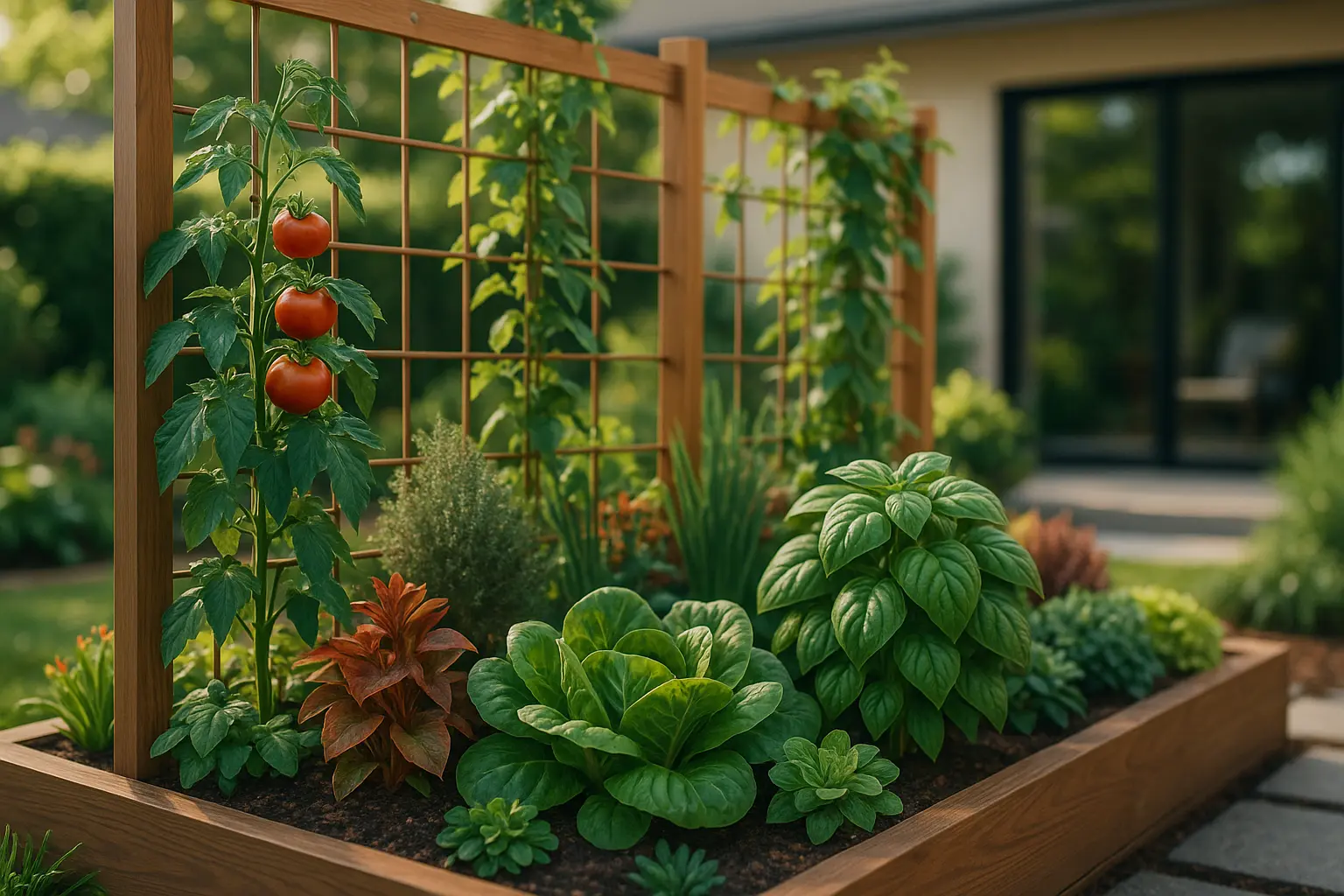
Walk through a garden centre these days and the line between the ornamental aisle and the vegetable aisle has started to blur. Rainbow chard sits next to dahlias. Blueberry shrubs get sold as hedging. What used to be called a kitchen garden, tucked behind a fence out of sight, is increasingly designed to be looked at as much as harvested. Extension research from the University of Florida and the University of Georgia both describe this shift under the same label: edible landscaping, the practice of folding food-producing plants directly into a garden’s visible design rather than segregating them in a separate plot.
An edible garden reads as aesthetically integrated when fruiting and ornamental plants are chosen and arranged by the same design logic, using color, form and structure, rather than treating food crops as a utilitarian afterthought tucked behind the shed. The plants that do this best tend to be dual-purpose by nature: attractive enough to hold their own in a border, productive enough to justify the space.
- Dual-purpose plants like rainbow chard, blueberry shrubs and espaliered fruit trees serve both roles at once.
- Raised beds and tiered planting give edible crops the same structural presence as ornamental focal points.
- Rising food costs and self-sufficiency concerns are accelerating what was already a design trend, per UGA’s Cooperative Extension.
- Companion planting and crop rotation keep an integrated edible garden productive without heavy chemical input.
What separates an edible garden from a vegetable patch
A vegetable patch is organized around rows and harvest efficiency. An edible garden is organized around the same visual principles as any ornamental border: repetition, contrast, height variation, seasonal succession. The plants happen to be edible, but the design decisions that place them are identical to the ones that would place a hosta or a rose.
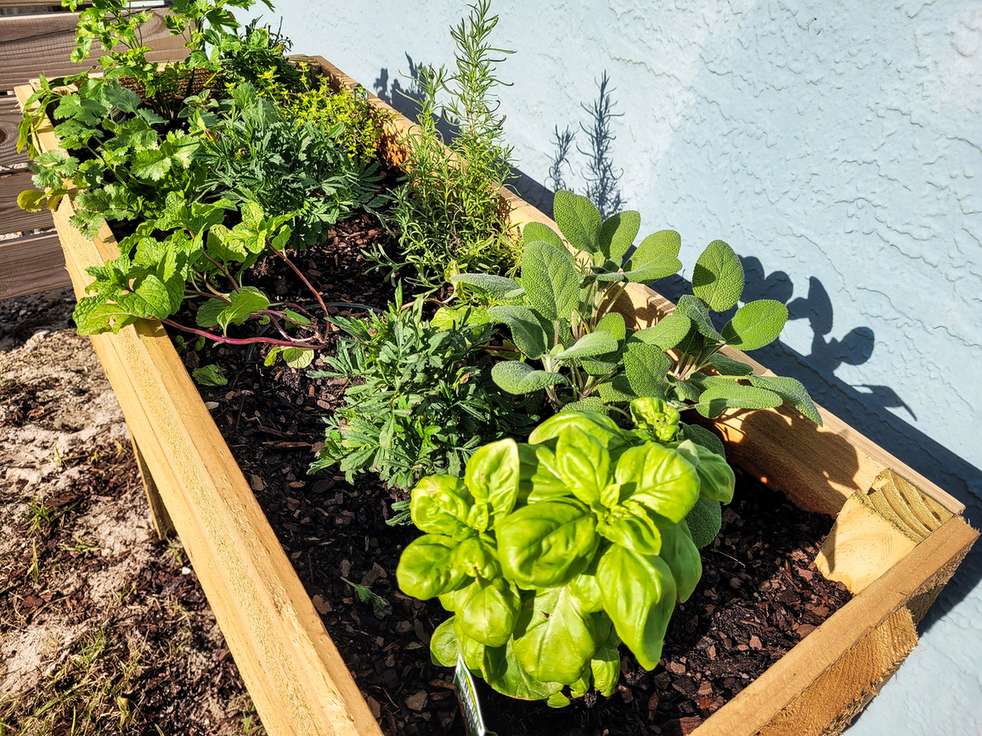
This distinction matters practically. A gardener who wants both beauty and a harvest needs to think about a plant’s foliage color and silhouette before its yield. Purple basil next to silvery artichoke leaves works as a color pairing independent of whether either ends up on a plate.
Choosing plants that carry their own design weight
Fruit trees anchor a design the way a specimen ornamental tree would. Apple, pear and cherry trees offer structure, shade and, in spring, a bloom display that rivals any purely decorative flowering tree. Espaliered against a wall or fence, they take up almost no ground space while still functioning as a strong vertical line.
Herbs like rosemary, thyme and lavender-adjacent sage work as low, textured edging in place of traditional boxwood, and they ask for far less water once established. Vegetables with strong visual character, ornamental kale, rainbow chard, purple-podded beans, do the heaviest lifting for making a food garden look intentional rather than makeshift.
Vertical structures extend the same logic upward. Trellises, arbors and simple wire supports let climbing beans, peas and cucumbers add a dimension a flat border cannot, which matters as much in a small courtyard as it does in a larger plot. A closer look at how vegetable rows and fruiting trees can be laid out for both yield and appearance is covered in a deeper dive into blending vegetable beds and fruit trees into a productive layout.
Table and border layout choices that keep the design coherent
| Design element | Ornamental role | Edible role |
|---|---|---|
| Espaliered fruit tree | Vertical focal line, spring blossom | Apples, pears in a compact footprint |
| Rainbow chard border | Bold foliage color, texture contrast | Continuous cut-and-come-again harvest |
| Herb edging | Low, structured border line | Rosemary, thyme, sage for the kitchen |
| Climbing bean trellis | Vertical screen, privacy | High yield in limited ground space |
Keeping the garden productive without leaning on chemicals
An integrated edible garden benefits from the same pest-management logic used in agroecology: diversity does part of the pest control work on its own. INRAE’s agroecology research shows that increasing plant diversity within a growing area helps regulate insect pests and pathogenic fungi without lowering yields, a principle that scales down comfortably to a home border. Planting basil near tomatoes or marigolds among root vegetables uses that same mechanism, since many companion plants release compounds that mask or repel common pests.
Soil health carries the rest of the load. Composting, mulching and rotating what grows where each season prevent the nutrient depletion that would otherwise force a gardener toward synthetic fertilizer to keep both the harvest and the display looking good.
Where pollinators fit into the picture
Fruit trees, herbs left to flower and many vegetable crops depend on pollinator visits to set fruit, which makes an edible garden a de facto pollinator garden as well. Most of that pollination still relies on wild bees and managed honeybee colonies rather than any mechanical alternative. Assisted-pollination technology exists but remains at an early research stage, and assisted-pollination robots still in early field trials are not yet a practical substitute for a garden that supports real pollinator populations through diverse, successive blooms.
FAQ
Can an edible garden really look as polished as a purely ornamental one?
Yes, when plants are chosen for foliage color, form and seasonal succession rather than yield alone. The visual gap between the two closes almost entirely once a gardener treats vegetables and fruit as design elements first.
How much space does an integrated edible garden actually need?
Very little, if vertical structures and raised beds are used well. A single trellis of climbing beans or a row of espaliered fruit can produce meaningfully while occupying a footprint smaller than a typical flower border.
Do edible plants need more maintenance than ornamentals?
Fruiting plants generally need more consistent watering and periodic feeding than many drought-tolerant ornamentals, though herbs and perennial vegetables like asparagus require comparatively little once established.
What is the easiest way to start without redesigning the whole garden?
Swap a few existing ornamental border plants for visually similar edible equivalents, such as ornamental kale for a decorative foliage plant, and expand from there once the layout proves itself.
Are edible landscapes suitable for organic or pesticide-free gardening?
They tend to suit it particularly well, since the plant diversity involved naturally supports the companion-planting and biological pest control approaches that reduce the need for chemical treatments.
The appeal of this approach is less about any single striking plant and more about the layout logic behind it: every plant earns its place twice over, once for how it looks and once for what it produces. That double duty is what keeps an edible garden from ever reading as an afterthought.
Sources: University of Florida IFAS Extension, edible landscaping guidance; University of Georgia Cooperative Extension, foodscaping trend reporting; INRAE, agroecology and plant diversity research.