
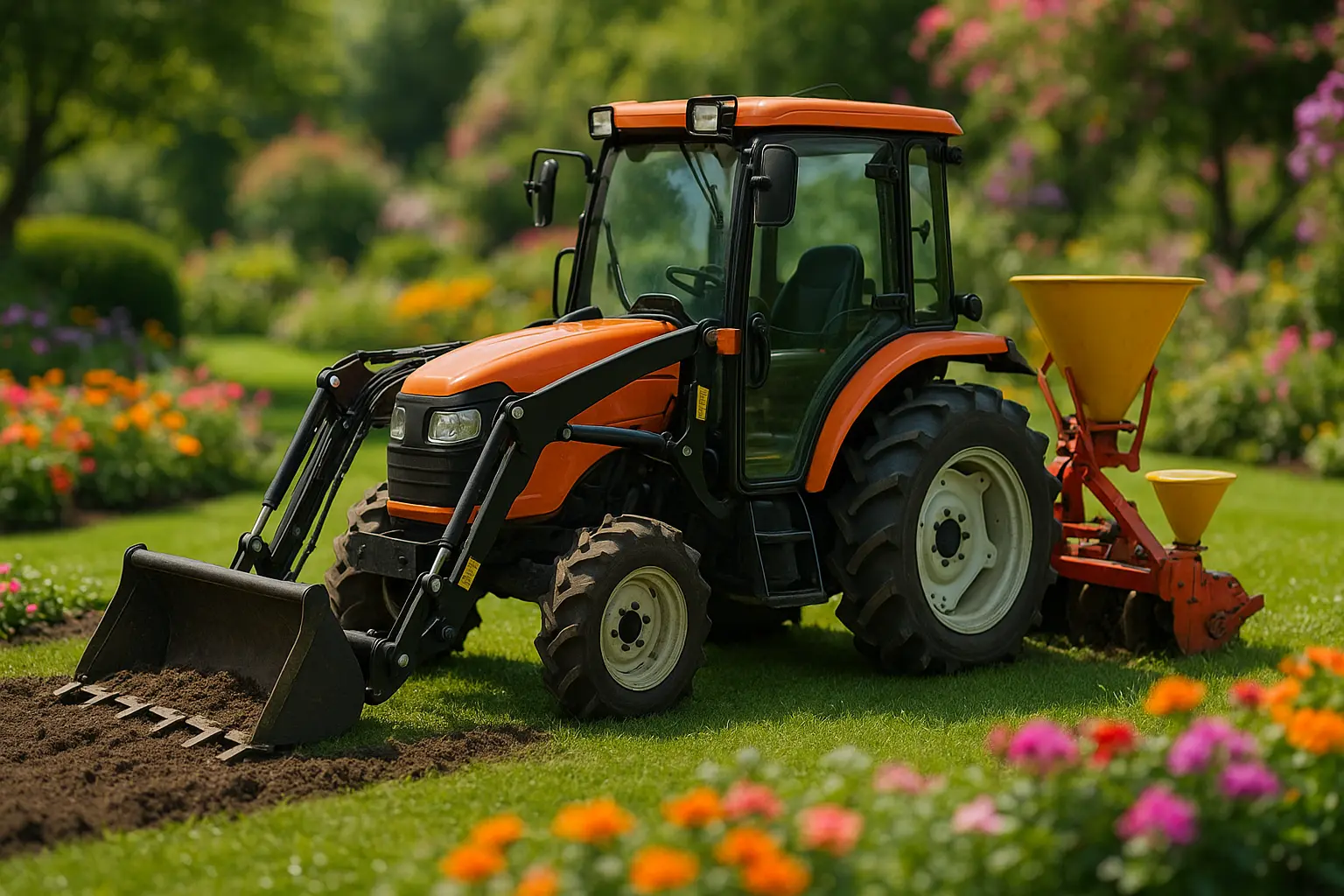
A compact tractor built for a five-acre vegetable plot and a compact tractor built for a two-acre municipal park have more in common than most buyers assume. Both need to move between tight rows without tearing up turf, both switch tasks several times a day, and both increasingly come from the same manufacturing line as full-size farm equipment, just scaled and reconfigured. That overlap is why so much of the machinery now used in professional landscaping did not start out designed for gardens at all.
Landscaping and grounds maintenance businesses adapt existing agricultural machinery, mainly compact tractors, rather than buying purpose-built landscaping equipment from scratch, because the base platform is already versatile and the attachment market for it is mature. A single tractor fitted with interchangeable implements, mowing decks, tillers, front loaders, aerators, can cover a wider range of tasks than several dedicated single-purpose machines, at a lower total equipment cost.
- Compact tractors are increasingly marketed for landscaping, municipal maintenance, and estate management, not only farming.
- Attachment versatility is the main economic argument: one tractor plus swappable implements often costs less than several single-task machines.
- Manufacturers such as John Deere, Kioti, and Massey Ferguson now design compact models with landscaping-specific attachment compatibility built in from the factory.
- Adapting existing machinery works well for established companies; it is less clearly cost-effective when new equipment has to be bought outright for the purpose.
What makes a farm tractor adaptable to landscaping work
The core of the adaptation is the tractor’s power take-off (PTO) and hydraulic system, the same interface that lets a farm tractor run a baler one day and a tiller the next. Landscaping attachment manufacturers build directly onto that standard interface rather than inventing a new one, which is why a compact tractor bought for general grounds work can run a rotary mower, a soil aerator, a box blade, or a brush cutter without swapping the base machine. This is less a redesign of farm equipment and more a recognition that the interface farm equipment already uses happens to suit landscaping tasks just as well.
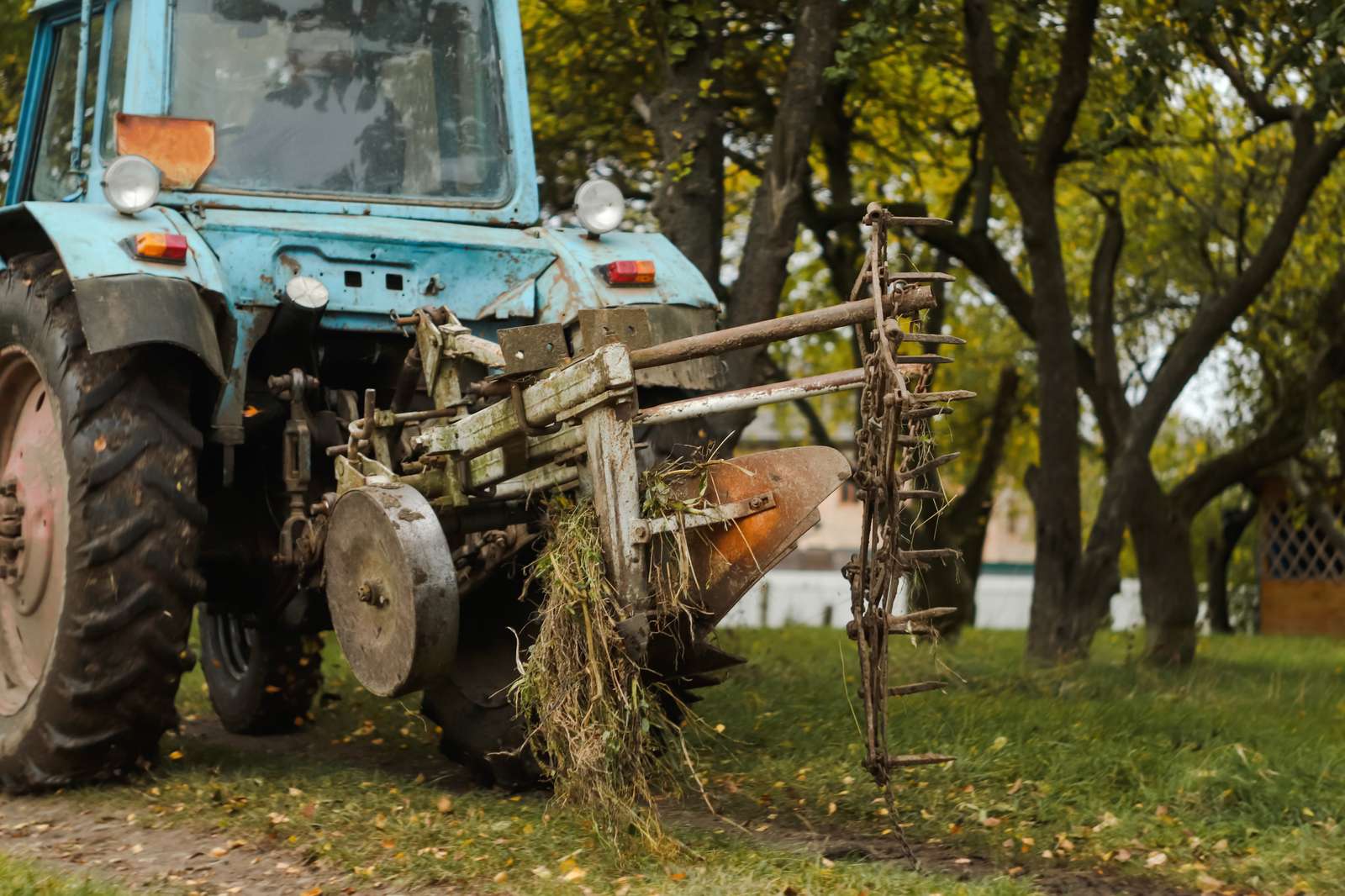
Suspension and steering adjustments matter more for landscaping-specific use than for open-field farming. A market garden operates on flat rows; a residential estate or public park often has slopes, tight paths, and obstacles like flower beds and trees to navigate around. Compact tractor models marketed toward landscaping and estate management increasingly ship with tighter turning radii and adjustable suspension as standard features rather than aftermarket modifications, which reflects how much this segment has grown as its own market rather than staying a farming afterthought.
Where full adaptation stops making financial sense
Retrofitting a tractor a company already owns with new attachments is close to always the cheaper option, since the core machine cost is already sunk. Buying a compact tractor specifically to adapt it for landscaping is a different calculation entirely, and it depends heavily on how many distinct tasks the business actually needs covered. A company that only mows and edges may find a dedicated commercial mower cheaper over its service life than a tractor plus several attachments bought new. The attachment route earns its value through breadth of use, not through being universally the lowest-cost option for every task.
This same logic increasingly pushes manufacturers in the opposite direction too: instead of adapting a farm platform, some are now building multi-purpose machines designed from the ground up for landscaping tasks rather than adapted from an agricultural base. Whether adaptation or purpose-built design wins out for a given company usually comes down to whether they already own compatible farm equipment or are buying new.
| Terrain type | Main adaptation needed | Typical attachment |
|---|---|---|
| Sloped or hilly estates | Reinforced suspension, wider stance | Slope mower deck |
| Compact urban gardens | Smaller frame, tighter turning radius | Micro-tiller, compact loader |
| Irrigation-heavy landscapes | Water-resistant components | Trench digger, drainage auger |
| Large public parks | High-throughput PTO capacity | Flail mower, brush cutter |
Where sensors and data collection fit into adapted machinery
Beyond mechanical attachments, many adapted machines now carry sensor packages originally built for precision farming: soil moisture readings, basic climate data, and simple usage logs. These were designed to help large-scale farms decide where to apply water or fertilizer, and landscaping companies use the same data for a smaller-scale version of the same decision, deciding which section of a property needs attention without walking the whole site first. None of this requires new sensor development specific to landscaping; it is largely the same agricultural IoT hardware repurposed for a smaller footprint.
This overlap with precision agriculture also explains why weeding technology crosses so easily between the two sectors. Selective, camera-guided weeding tools originally developed for row-crop farming are now marketed directly to landscaping companies, since the underlying computer vision task, telling a weed from a desired plant, does not actually change between a farm field and a public flower bed. Reviewing how robotic weeding tools compare with manual and chemical weed control is a useful next step for a company already considering adapted machinery for other tasks.
FAQ
Is it cheaper to adapt existing agricultural machinery than buy landscaping-specific equipment?
It is generally cheaper if the business already owns a compatible tractor. Buying new equipment specifically to adapt it is a separate calculation that depends on how many distinct tasks the attachments need to cover.
What is the main technical link between farm tractors and landscaping equipment?
The power take-off and hydraulic interface, the same connection point that lets a single tractor run different implements, whether the implement was designed for farming or for landscaping.
Do landscaping attachments require special training to use safely?
Yes, particularly for attachments involving cutting blades, augers, or hydraulic lifts. Operators should be trained on each specific attachment, not only on the base tractor.
Can any compact tractor be adapted for landscaping use?
Most compact tractors with a standard PTO and three-point hitch can accept common landscaping attachments, but suspension, ground clearance, and turning radius vary enough between models to matter for uneven or tight terrain.
Adapting existing agricultural machinery remains the practical default for most landscaping and grounds maintenance businesses, precisely because the underlying platform was never as farm-specific as its origin suggests. The tools follow the task, not the label on the machine that carries them.
Published 29 July 2026.
Sources: Grand View Research, compact agricultural tractors market analysis; Ag-Pro / John Deere landscaping attachment guidance; FAO Agriculture 4.0 report on sustainable agricultural mechanization.