
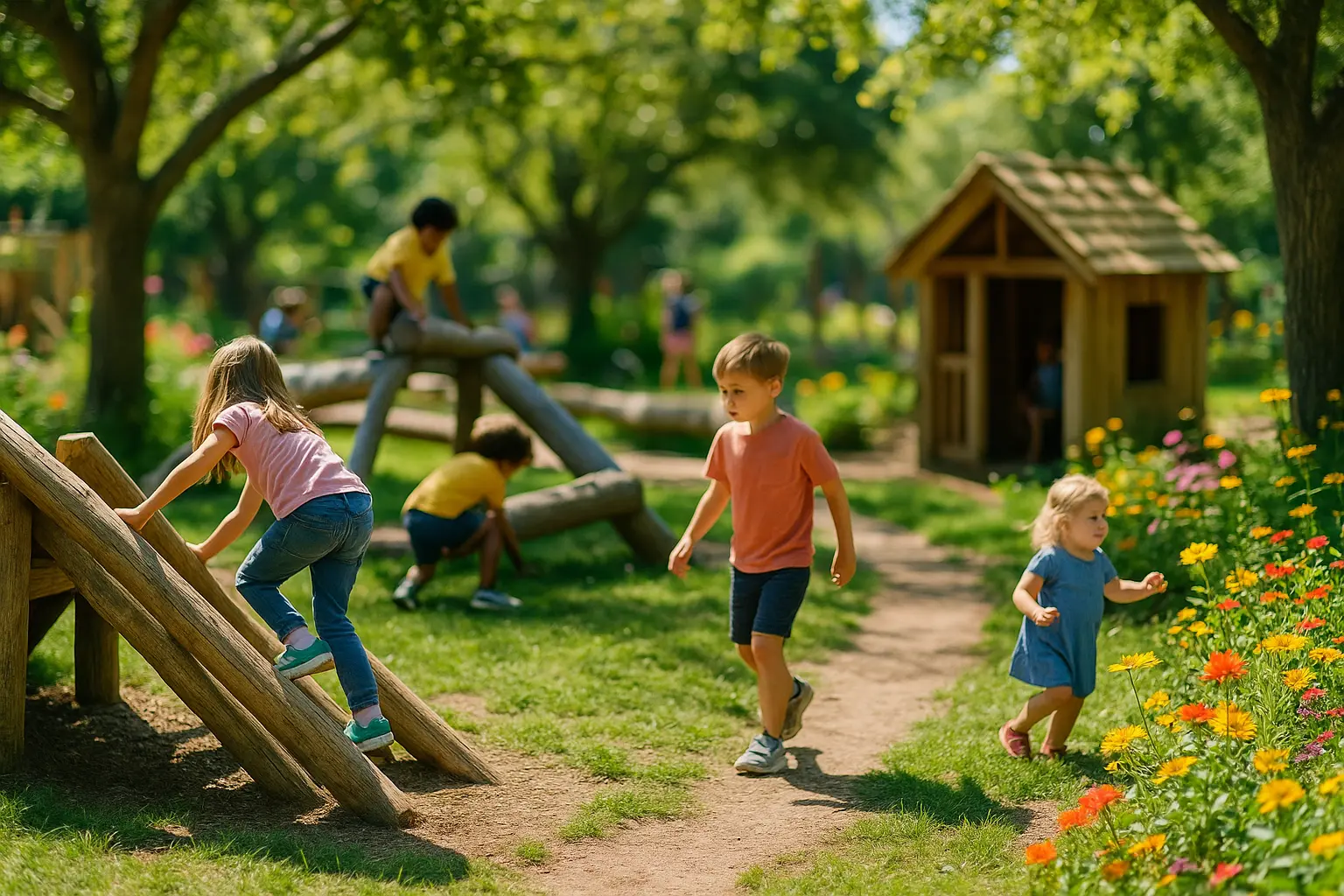
A child left alone with a fallen branch, a patch of mud, and a pile of loose stones will usually invent three different games before an adult finishes explaining the rules of one. That instinct is exactly what a natural play area is designed to protect, rather than replace with fixed equipment that only does one thing.
A natural play area is an outdoor space that uses loose, varied materials, such as logs, sand, water, and plants, instead of fixed manufactured equipment, to encourage open-ended play, physical activity, and sensory exploration. Research on outdoor risky play consistently links this kind of naturalized environment to better physical coordination, stronger risk-assessment skills, and improved social interaction compared to standardized playground equipment.
- Loose parts (branches, stones, sand) support imaginative play in ways fixed slides and swings can’t replicate.
- Research shows naturalized playspaces increase both the variety and physical intensity of children’s movement compared to standard equipment.
- Risk-benefit assessment, not risk elimination, is now the standard framework used by playground designers and educators.
- Inclusive design (wide paths, sensory zones, varied seating) ensures the space works for children of different abilities.
Why open-ended materials matter more than fixed equipment
Fixed playground equipment, a slide, a swing set, does exactly one thing regardless of who uses it. Loose natural materials do the opposite: a branch becomes a sword, a bridge, or a fishing rod depending entirely on what the child brings to it that day. Research on naturalized playspaces has found that varied terrain, uneven surfaces, craggy features, and shifting materials like sand or water specifically encourage more physically intense and more diverse movement than standardized equipment offers.
What the research actually says about risky play
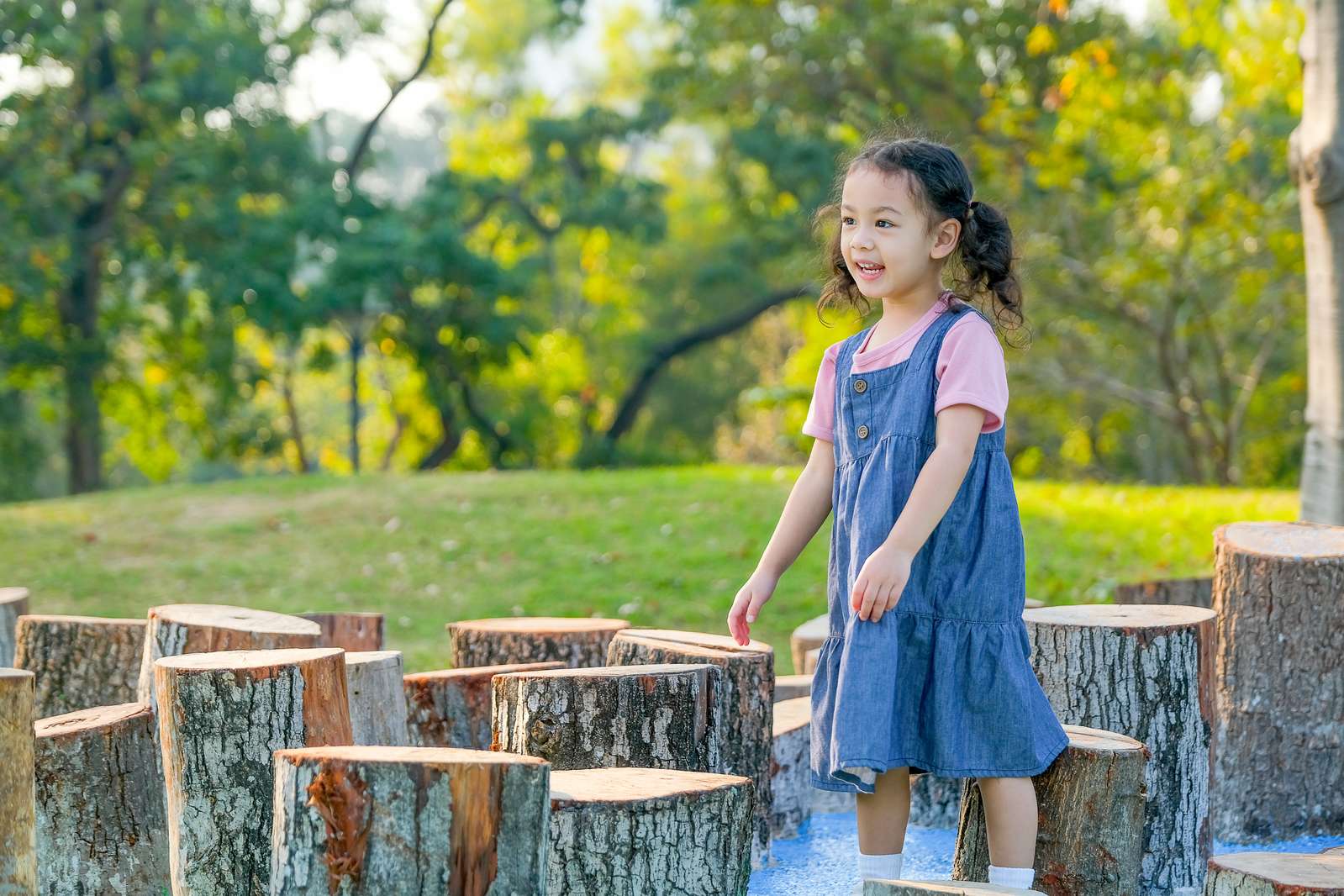
“Risky play” sounds alarming out of context, but the research behind it is fairly consistent: supervised risk-taking in outdoor play is associated with better physical activity levels, stronger social competence, and improved cognitive development in children, according to reviews of outdoor adventure and nature-based play research. The key shift in how professionals design these spaces is a move from risk elimination toward risk-benefit assessment, a structured method that weighs the developmental value of a challenging feature, a climbing log, an uneven path, against its actual injury risk, rather than removing anything with any risk at all.
This doesn’t mean an unsupervised free-for-all. It means the design intentionally keeps some manageable challenge in the space (a log to balance on, a slope to navigate) rather than flattening every surface and rounding every edge, since that manageable challenge is where the coordination and judgment benefits actually come from.
Core design elements that make a natural play area work
A few recurring elements show up across most well-reviewed natural play designs. Diverse materials, wood, stone, sand, and water, stimulate different senses and support tactile learning in a way a single rubber surface cannot. Interactive features such as water pumps, informal climbing structures, and balance logs develop fine motor skills and problem-solving through repeated, self-directed use rather than instruction. Seasonal planting adds a layer that fixed equipment can never offer: children observing the same space change texture and color across the year build an intuitive sense of natural cycles that a static structure can’t teach.
Safety in this context means something more specific than “risk-free.” Soft, impact-absorbing ground surfaces under climbing features, well-maintained natural materials replaced before they rot or splinter, and clear sightlines for supervising adults all reduce the chance of a serious injury while leaving the manageable, developmentally useful risk intact.
Designing for children of different abilities
Universal design principles, ramps, tactile paths, and sensory garden elements, ensure a natural play area works for children with different physical or sensory needs rather than defaulting to a single ability profile. Fragrant plantings and simple sound-producing installations extend the sensory range of the space for children who engage with it primarily through smell or hearing rather than sight or movement.
Involving parents, caregivers, and children themselves in the design process, rather than finalizing a plan without local input, tends to produce spaces that better reflect how a specific community actually wants to use the area. Open layouts with good visibility across the site also reduce opportunities for bullying or exclusion, since isolated corners are harder for supervising adults to monitor.
This same inclusive-design logic carries directly into related garden work. The same inclusive-design thinking applied to gardens for seniors and reduced mobility relies on nearly identical principles, wide accessible paths, sensory planting, varied seating, even though the two audiences are at opposite ends of the age range. It’s also closely related to how therapeutic gardens apply similar sensory-design thinking for adults, since both approaches treat sensory engagement as a design requirement rather than a decorative extra.
FAQ
Is a natural play area less safe than a standard playground?
Not when designed properly. Risk-benefit assessment keeps genuinely dangerous hazards out while intentionally preserving manageable, developmentally useful challenges, an approach supported by current research on child development rather than a relaxed attitude toward safety.
What age range benefits most from natural play spaces?
Research on naturalized playspaces has looked closely at younger children in particular, though the open-ended, loose-parts approach scales well across a wide age range, since the same materials support different levels of complexity depending on the child.
Do natural play areas require more maintenance than standard playgrounds?
Often yes, since natural materials like wood and plants need periodic replacement or upkeep that manufactured equipment doesn’t, though this maintenance is generally less costly than replacing damaged manufactured play structures.
How can a natural play area be made accessible to children with mobility challenges?
Wide, firm pathways, ramps instead of steps where terrain allows, and sensory elements that don’t require climbing all help ensure the space works for children with different physical abilities.
Published: July 29, 2026. Last updated: July 29, 2026.
Sources: Children and Nature Network research digest on risk-taking in natural environments; peer-reviewed studies on naturalized playspace design (PMC, Journal of Outdoor and Environmental Education).