
Storm King Art Center sits on 500 acres of the Hudson Valley, and its collection includes weathering-steel pieces by Mark di Suvero that measure tens of feet across, set against open lawns and rolling hills rather than the white walls of a museum. That contrast, a monumental sculpture against a living, changing landscape, is the entire case for putting contemporary art in a garden instead of a gallery.
Integrating contemporary sculptures and installations into a garden works because the surrounding landscape changes with the seasons, the light, and the weather, giving a static art piece a different context every time it’s seen, something a fixed indoor gallery can never offer. This only works well, though, when the piece, its materials, and its placement are chosen with the specific garden and climate in mind, not dropped in as an afterthought.
- A garden setting exposes a sculpture to changing light and seasons, giving it a different visual context throughout the year.
- Durable materials, weathering steel, bronze, treated stone, hold up to outdoor conditions far better than materials designed for interior display.
- Placement should respond to the existing landscape rather than treat the garden as a blank pedestal.
- Regular maintenance, cleaning every few months and resealing every one to two years, keeps outdoor pieces from degrading faster than intended.
Why a garden setting changes how a sculpture is experienced
A sculpture indoors sits under constant, controlled lighting and never really changes. The same piece outdoors shifts throughout the day as the sun moves, and again throughout the year as surrounding foliage grows, flowers, and dies back. A bronze figure half-hidden behind summer growth reads completely differently once the leaves drop in autumn. This isn’t a compromise compared to a museum setting, it’s a different kind of artwork altogether, one that includes time and season as part of the composition rather than fighting to keep everything static.
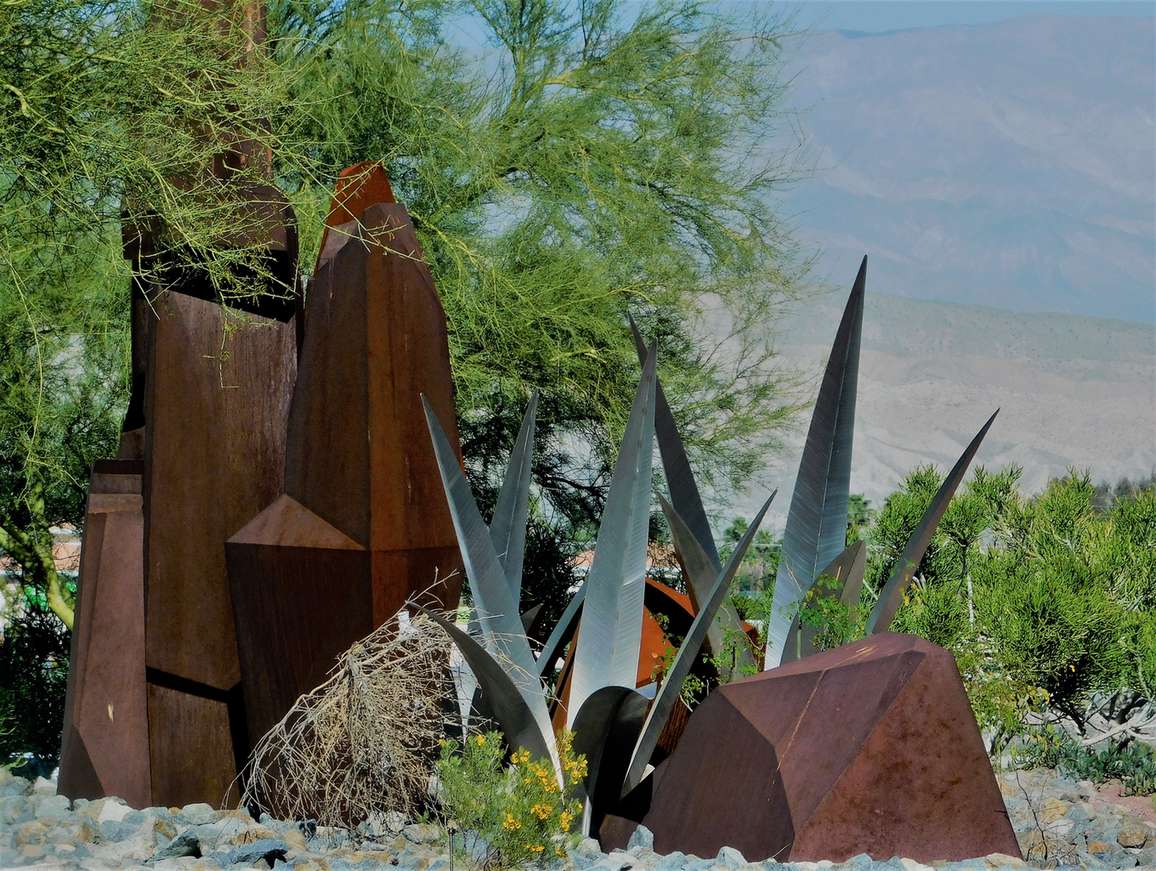
Reflective materials add another layer specific to outdoor placement. A polished or mirrored surface set near water or dense planting captures the sky and surrounding greenery, effectively making the landscape part of the piece rather than just its backdrop. Wind-responsive kinetic elements do something similar with sound and motion, reacting to conditions a gallery would never have to account for.
Choosing materials that actually survive outdoor conditions
Outdoor sculpture needs to handle exposure that would ruin most interior art materials within a season. Weathering steel, the material behind many of Storm King’s largest works, develops a stable protective rust layer that actually improves its resistance to further corrosion over time. Bronze and treated stone, including granite, marble, and limestone, are the other materials most commonly used across major outdoor sculpture collections, chosen specifically for their ability to withstand rain, temperature swings, and direct sun without structural degradation.
Maintenance is not optional once a piece is outdoors. Conservation practice for outdoor sculpture generally calls for cleaning every three to six months, with a protective sealant or wax reapplied every one to two years depending on the material and local climate. Skipping this schedule doesn’t just affect appearance, it can accelerate structural decay that’s far more expensive to reverse than a routine cleaning would have cost.
Placing a piece so it works with the garden, not against it
The biggest design mistake is treating the garden as an empty plinth and dropping a piece into whatever open space exists. A stronger approach starts with the landscape’s own structure, a natural sightline, a slope, a clearing framed by trees, and asks what piece and placement would complete that space rather than compete with it. Scale matters here more than in an interior setting: a piece that reads as monumental in a small gallery room can disappear entirely against open parkland, while a modest piece can dominate a tightly enclosed courtyard.
Color and material choice should also respond to what’s already growing nearby. How color and texture choices already shape the mood of a garden applies directly to sculpture placement, since a piece in a warm, weathered material reads differently against silver-leaved planting than against dense, dark green foliage. Lighting design extends this consideration into the evening: how night lighting can dramatically change how a piece reads after dark is worth planning from the start rather than adding as an afterthought once the piece is already installed.
Budget, commissioning, and working with the right professionals
Bringing contemporary art into a garden is rarely a solo decision made purely on aesthetic instinct. Landscape architects and horticulturists are typically brought in alongside the artist during the planning stage, since a piece that looks striking on paper can still fail if it’s placed where root growth will eventually undermine its foundation, or where seasonal shade will hide it for half the year. That collaboration works best when it starts before the piece is fabricated, not after, so the material, scale, and finish can be matched to the specific site conditions from the outset rather than adjusted around a finished object.
Budget realities also shape what’s achievable. A large-scale commissioned piece in weathering steel or bronze represents a significant investment before installation and ongoing maintenance costs are even factored in, which is why many private gardens start smaller: a single well-placed found-object piece, a commissioned work in a more modest material like treated timber, or a rotating loan arrangement with a local artist rather than a permanent acquisition. None of these approaches are lesser versions of a museum-scale collection, they’re simply matched to a different scale of space and budget, and the underlying design logic, letting the landscape and the piece respond to each other, applies just as much to a single garden sculpture as it does to a five-hundred-acre sculpture park.
Gardens as gathering spaces around art
Public gardens that host contemporary sculpture and installations tend to become informal cultural destinations in their own right, drawing visitors who might not otherwise seek out a museum. This works because the art becomes part of a broader outdoor experience, a walk, a picnic, a change of scenery, rather than the sole reason for the visit. That combination hasn’t diluted the seriousness of the work at institutions that have built entire reputations around it, Storm King and Yorkshire Sculpture Park among them, where the landscape and the art are treated as equally deliberate parts of the same design.
For a private garden, the same principle scales down without losing its point. A single well-placed piece, chosen for durability and matched to the specific character of the planting around it, can anchor a whole section of the garden the way a mature tree or a water feature would, giving visitors a reason to pause rather than simply walk past.
Published: July 29, 2026. Last updated: July 29, 2026.
Sources: Storm King Art Center institutional materials; conservation guidance on outdoor sculpture maintenance (National Park Service, Association for Public Art).