
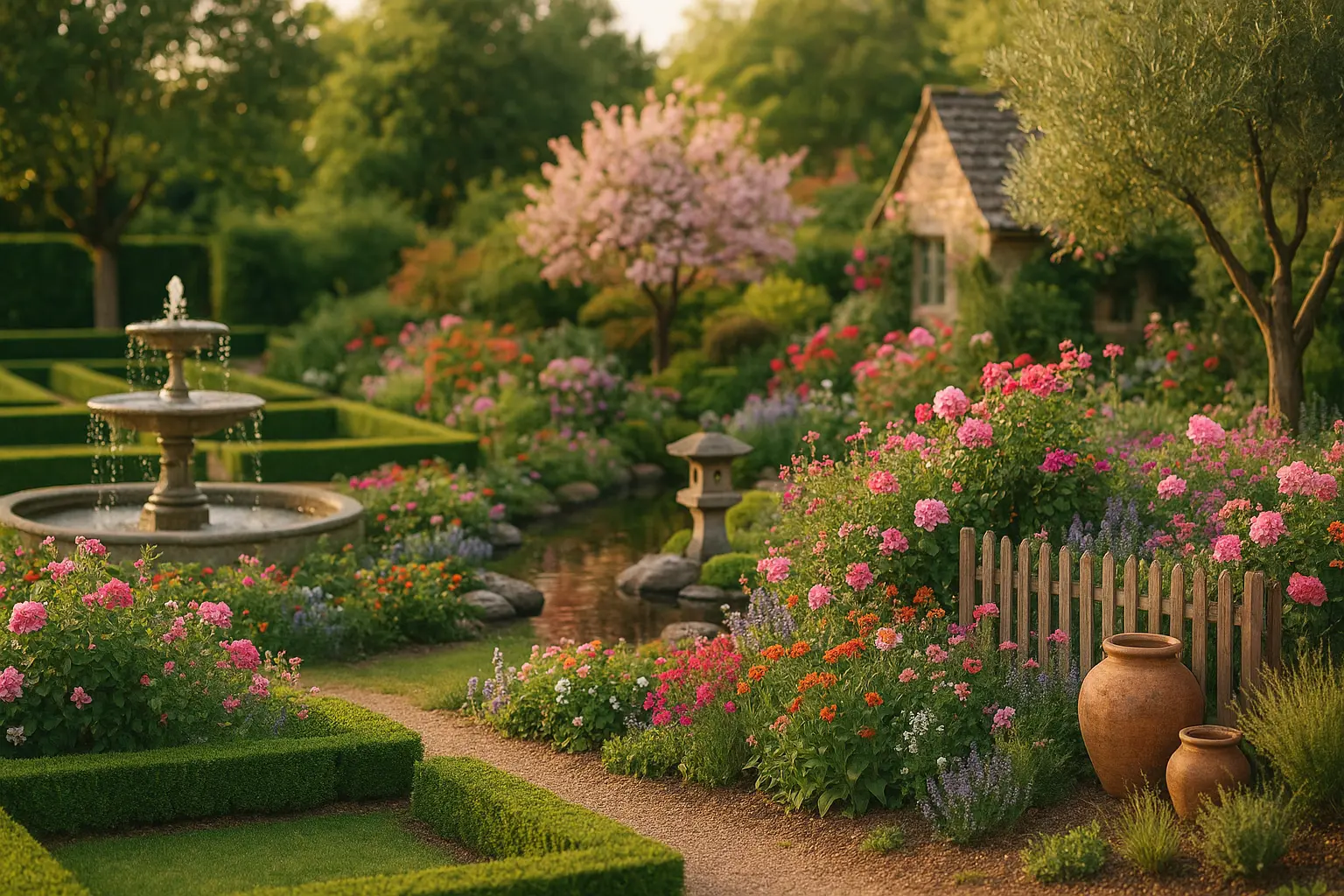
Why does a garden laid out with military precision and a garden that looks like it grew on its own both count as good design? The answer lies in history. Every major garden style carries the fingerprint of the culture, climate, and politics that produced it, and understanding those origins turns a simple planting plan into a deliberate design choice rather than a copied template.
Garden styles differ mainly in how much control they impose on nature, from the strict geometry of French formal gardens to the deliberate wildness of English cottage gardens, the symbolic restraint of Japanese gardens, and the drought-adapted ease of Mediterranean gardens. Choosing between them is less about taste alone and more about climate, maintenance capacity, and the mood a space is meant to create.
- French formal gardens rely on symmetry and clipped geometry, a legacy of André Le Nôtre’s work at Versailles starting in 1662.
- English cottage gardens emerged from working plots and were reinvented as a deliberate style in 1870s England, in direct reaction against formal estate gardens.
- Japanese gardens use asymmetry and restraint to represent larger natural landscapes in miniature.
- Mediterranean gardens lean on drought-tolerant planting adapted to a hot, dry climate rather than imported irrigation-heavy ideals.
French Formal Gardens: Nature Under Strict Command
The French formal garden, or jardin à la française, reached its defining moment when André Le Nôtre began work on the gardens of Versailles in 1662, a project that occupied him for the rest of the century. Le Nôtre had studied perspective and optics under the painter François Vouet, and he applied that training directly to landscape: axial symmetry, rectilinear layouts, and sightlines engineered to make a garden appear even larger than it already was.
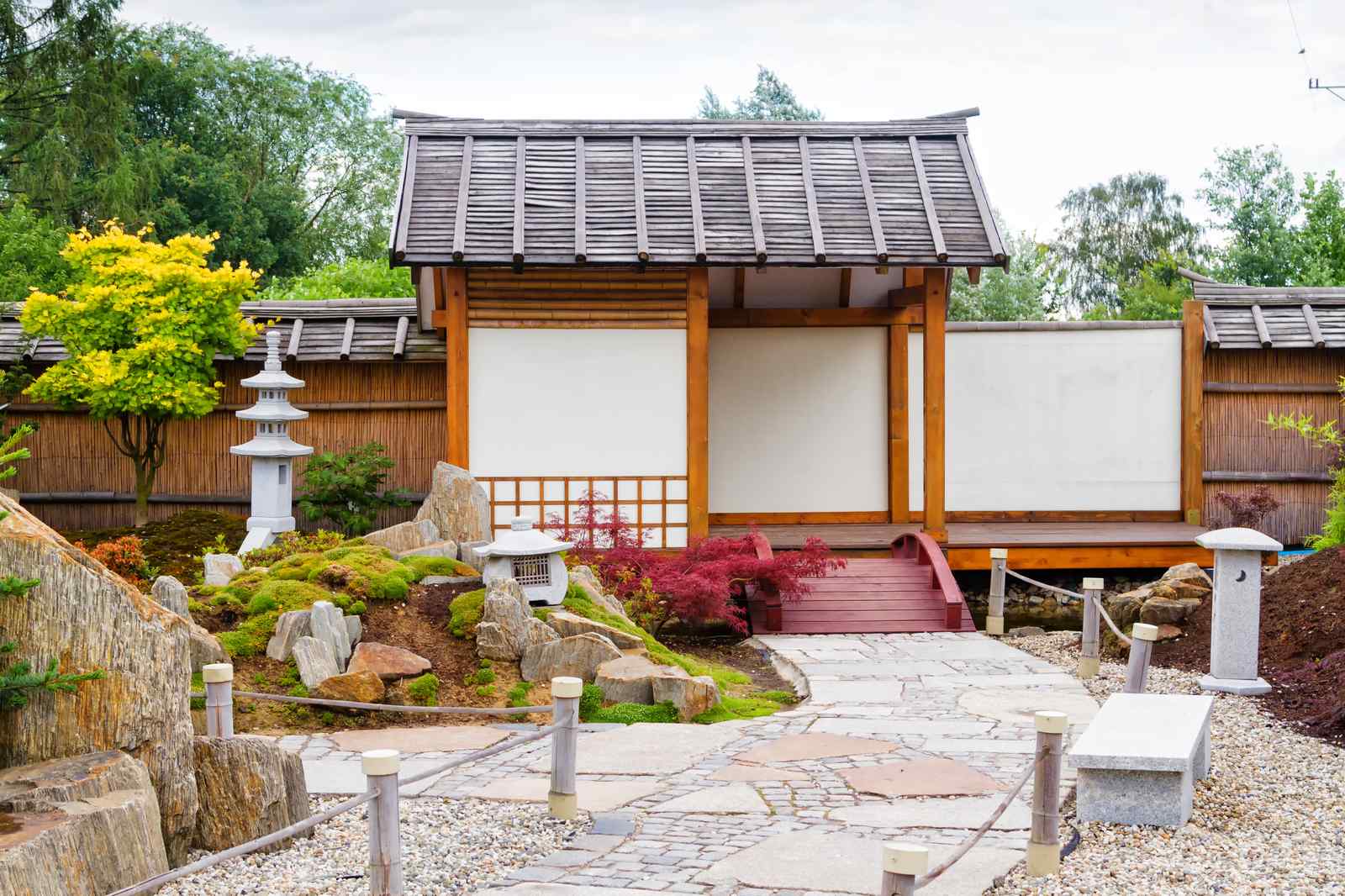
The style demands tightly pruned hedges, gravel pathways, and reflective water features arranged along a central axis, with topiary shaped into precise geometric forms. It is a garden built to be viewed from a distance as much as walked through, which is why estates designed in this style so often place the main structure on rising ground overlooking the layout below.
English Cottage Gardens: Deliberate Informality
English cottage gardens have a more modest origin than their French counterpart. They trace back to 16th-century rural England, where small plots around a cottage served a practical purpose: growing vegetables, herbs, and a few flowers within a confined space. The romanticized, densely planted version most people picture today is largely an 1870s reinvention, a conscious rebellion against the rigid, heavily staffed estate gardens of the previous era.
The look depends on dense, overlapping planting rather than open space between specimens. Hollyhocks, foxgloves, and roses spill past their borders on purpose, and pathways are narrow and meandering rather than straight. Brick, cobblestone, and weathered wood suit the aesthetic far better than polished stone. It reads as effortless, but achieving that look actually requires a working knowledge of which plants self-seed politely and which ones will take over the entire bed.
Japanese Gardens: Restraint as a Design Principle
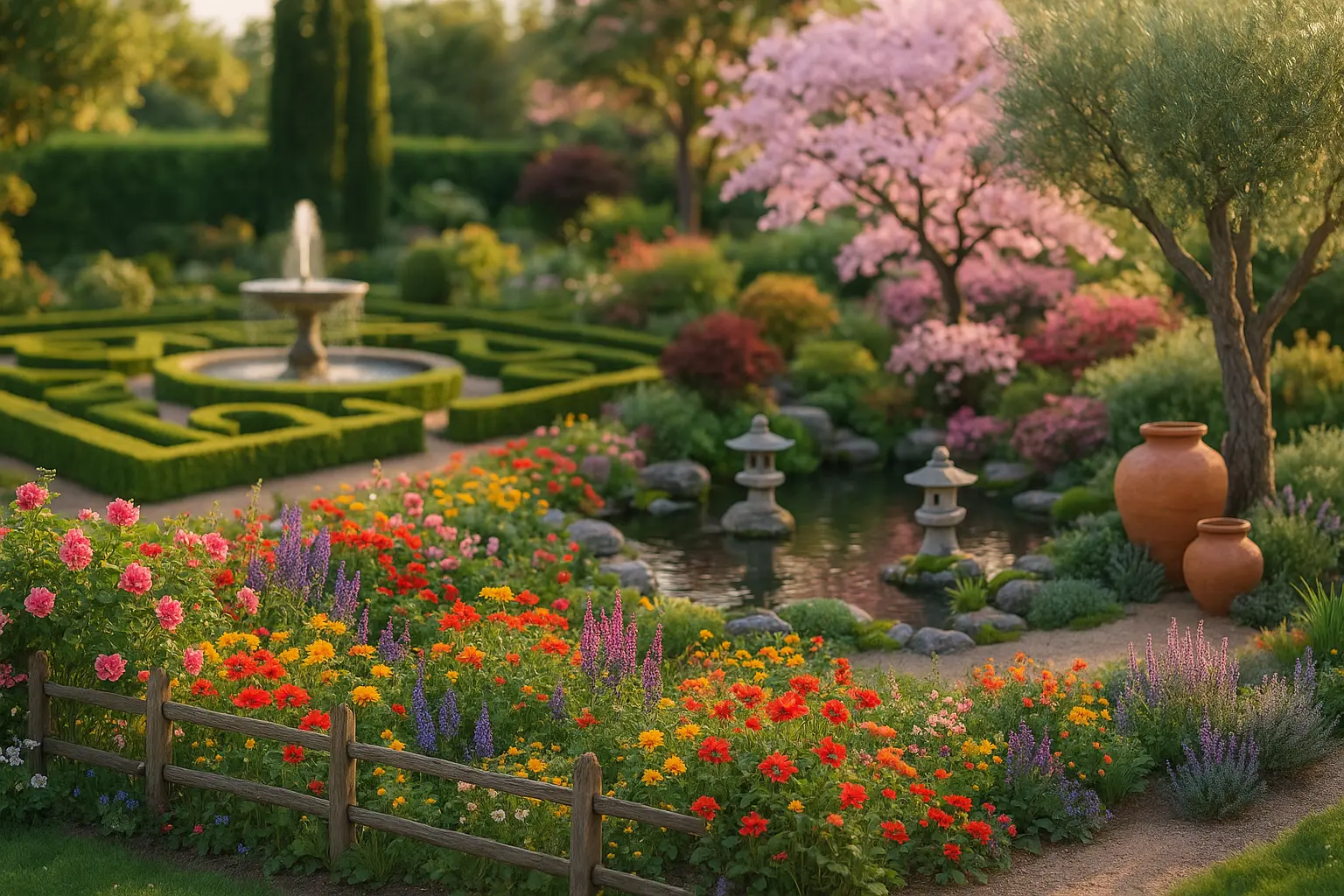
A Japanese garden is built around asymmetry, naturalism, and deliberate austerity rather than abundance. Rocks, sand, and water are positioned to stand in for mountains, rivers, and seas, compressing a much larger landscape into a contemplative space. Maples, cherry blossoms, and bamboo supply seasonal color and texture without ever overwhelming the composition.
Water almost always plays a central role, whether as a still reflective pond or a quietly moving stream, and stepping stones or bridges are placed to slow a visitor’s pace and encourage mindful movement rather than a direct route from one point to another. Designing convincingly in this style requires real familiarity with the cultural and philosophical ideas behind it, not just the visual vocabulary, since a Japanese garden that skips the restraint tends to read as a rock garden rather than the real thing.
Mediterranean Gardens: Designed Around Climate, Not Around Trend
Mediterranean gardens start from a practical constraint: a hot, dry climate that punishes thirsty planting choices. Lavender, olive trees, and rosemary dominate for good reason, since all three tolerate drought and reward minimal irrigation with strong scent and color. Terracotta pots and earthenware accents complete a look that owes as much to necessity as to aesthetics.
Water features exist here too, but in a more understated form: a small fountain or shallow pool rather than the grand reflective basins of a French garden. Stone and brick pathways integrate naturally with the surrounding landscape, and the entire style holds up well in regions now facing longer dry seasons, which is one reason Mediterranean planting principles are increasingly borrowed outside their original climate zone.
| Garden style | Water needs | Maintenance level |
|---|---|---|
| French formal | Moderate to high | High, frequent precise pruning |
| English cottage | Moderate | Moderate, seasonal editing |
| Japanese | Low to moderate | High, precision pruning and raking |
| Mediterranean | Low | Low once established |
Despite their obvious differences, all four styles rely on the same underlying tools of perspective and sightlines, only pointed in opposite directions. A French formal garden uses a long, straight axis to make a space look grander and more expansive than it is. A Japanese garden hides its full extent behind rocks and planting on purpose, revealing the space gradually as a visitor moves through it. Recognizing that shared toolkit is often more useful for a designer than memorizing the surface-level plant lists associated with each tradition.
A garden style is rarely a purely visual choice. It is usually a climate and a culture, translated into planting.
None of these styles exist in a vacuum, and the reasoning behind each one connects to a broader question worth exploring on its own: how history and cultural context continue to inspire garden design well beyond these four traditions. The same logic also underpins the fundamental principles of harmony, balance, and perspective that show up, in different proportions, in every style described here.
Frequently Asked Questions
Which garden style requires the least maintenance?
Mediterranean gardens generally demand the least ongoing care once established, since their drought-tolerant plant palette needs minimal watering and tolerates infrequent pruning far better than a formal French layout.
Can elements of different garden styles be combined?
Yes, and it is common in practice. A garden might use a Japanese-inspired water feature alongside Mediterranean drought-tolerant planting, as long as the combination is planned with intent rather than assembled from unrelated inspiration photos.
Why do English cottage gardens look unplanned when they actually require planning?
The effortless look depends on knowing which self-seeding plants stay in bounds and which ones spread aggressively, plus regular editing throughout the season. Without that oversight, the garden tips from charming into genuinely overgrown.
Is a French formal garden practical for a small residential yard?
A scaled-down version can work using the same principles of symmetry and clipped hedging, but the high pruning frequency required makes it a demanding choice for anyone without regular access to professional maintenance.
What makes a Japanese garden different from a rock garden?
A true Japanese garden arranges rocks, water, and plants to symbolize a larger natural landscape according to specific philosophical principles, rather than using rocks purely as a low-maintenance ground cover material.
Each of these four styles solves a different problem: control, abundance, symbolism, or climate. Recognizing which problem a client is actually trying to solve, before reaching for a Pinterest board, is what separates a garden that merely looks like a style from one that genuinely belongs to it.