
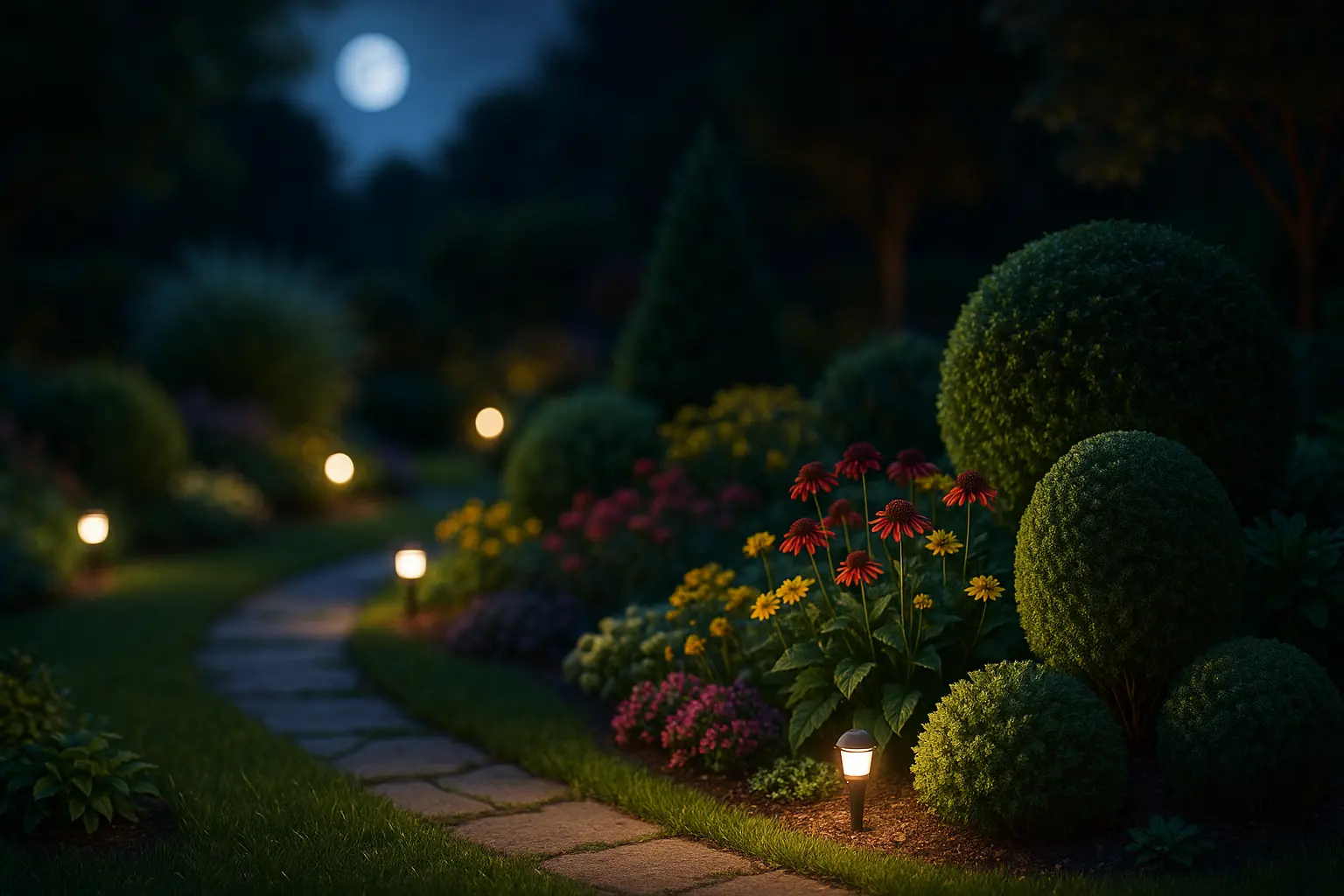
A firefly that stops flashing its courtship signal under a bright porch light will not find a mate that season. That single fact, documented by conservation researchers tracking insect decline near artificial light sources, says more about nighttime landscaping than any lighting catalogue ever will. Gardens after dark are not just about visibility. They are an ecosystem that keeps working once the sun goes down, and the way we light them either supports that ecosystem or quietly disrupts it.
Nighttime garden lighting works best when it combines the least artificial light necessary with fixtures placed for a clear purpose, rather than simply flooding a space with brightness. Warm, shielded, downward-facing light preserves both the atmosphere of a garden and the nocturnal wildlife that depends on darkness to feed, migrate, and reproduce.
- Moonlight, reflective paving, and solar fixtures can cover a surprising share of a garden’s nighttime ambiance without adding a single new light source.
- Color temperature matters as much as brightness: warmer, amber-toned LEDs below roughly 3000K disturb insects and nocturnal animals far less than cool blue-white light.
- Shielded, downward-directed fixtures and timers cut both energy use and light pollution at the same time.
- A garden lit with intent, not just with more lumens, tends to look better and cost less to run.
What Natural Light Still Contributes After Sunset
Darkness is never absolute in a garden, and moonlight remains the original nighttime light source worth designing around. A garden oriented to catch moonlight across a lawn or a still pond gains a soft, silvery glow that no fixture fully replicates, and it costs nothing to run. Plants with pale or silvery foliage, such as lamb’s ear or white-flowering varieties, reflect this light particularly well and are worth placing where the moon actually reaches.
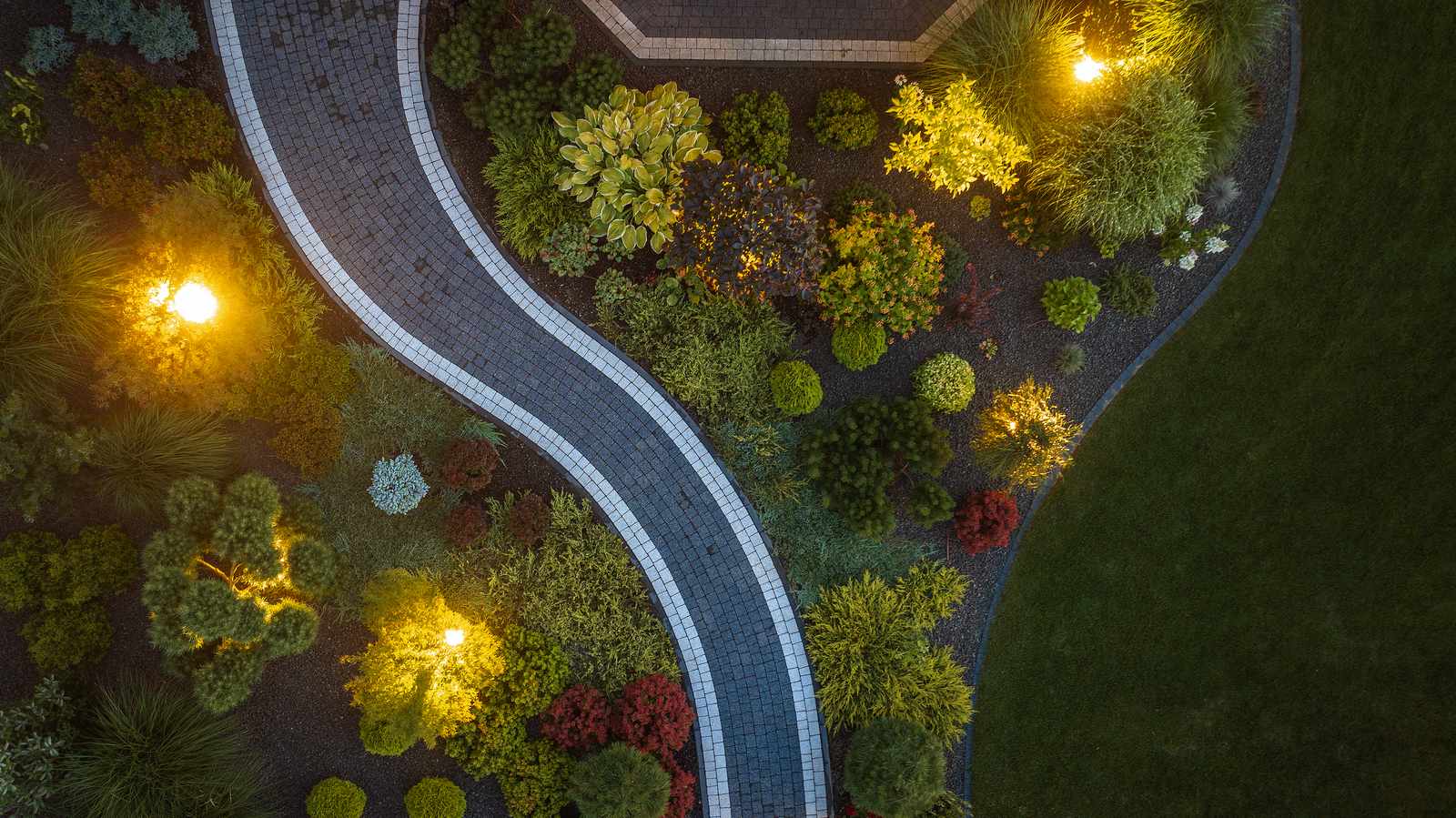
Reflective surfaces extend this effect further. Light-colored paving, water features, and even glossy foliage bounce ambient light around a space, which means a garden designer can often reduce the number of fixtures needed simply by paying attention to what already reflects what little light is available. A pond positioned to catch both moonlight and the glow of a distant streetlamp does double duty as a design feature and a natural light amplifier.
Designing Artificial Light With a Clear Purpose
Artificial lighting earns its place in a garden when every fixture answers a specific question: what is this light actually for? A path light guides footsteps. An uplight on a mature tree draws the eye to its structure. A downlight over a seating area extends its use into the evening. Lighting installed without this kind of reasoning tends to multiply fixtures instead of clarifying the space, which wastes both energy and money.
Color temperature deserves particular attention here. Cooler, blue-white light reads as clinical and can wash out plant colors, while warmer amber tones create a more inviting mood and, as detailed further below, cause measurably less disruption to nocturnal species. Smart controls, including timers and motion sensors, let a garden stay dark by default and light up only when someone is actually present, which is both a security feature and an ecological one.
The Real Ecological Cost of Overlit Gardens
Artificial light at night is now recognized as a measurable driver of wildlife disruption, not a marginal side effect of modern life. According to the DarkSky International research synthesis updated in 2024, thousands of published studies now document how artificial light interferes with the hunting, migration, and reproductive behavior of nocturnal species. Migratory birds are disoriented by bright building and garden lighting, a pattern also confirmed in the U.S. National Park Service’s review of artificial light effects on wildlife, and fireflies reduce their courtship flashing near excessive lighting, which directly threatens local population stability.
Some cities are already responding. In September 2024, the Finnish city of Lahti began trialing pollinator-friendly street lamps that filter out the blue portion of the light spectrum, starting with a dozen fixtures. That kind of spectrum-conscious approach, still experimental at municipal scale, is exactly the direction private garden lighting can already take today without waiting for regulation.
Practical Habits That Reduce Light Pollution Without Sacrificing Style
Shielding is the single most effective habit: a fixture that directs light downward, toward the ground or the feature it illuminates, rather than out into the sky, prevents the glare and skyglow that define light pollution. Pairing shielded fixtures with timers, so gardens go dark after a set hour rather than staying lit all night, further limits the disruption to wildlife while cutting electricity use.
Solar-powered path lights and warm-toned LEDs make this easier than it used to be. They no longer trade efficiency for atmosphere, and a garden lit this way tends to feel calmer rather than clinical, which is often exactly the mood clients ask for in an evening garden anyway.
| Lighting approach | Best use | Impact on wildlife |
|---|---|---|
| Moonlight and reflective surfaces | Ambient mood, no added cost | None, purely natural |
| Warm solar path lights | Walkways, low-level guidance | Low, if shielded and downward-facing |
| Shielded warm LED uplights | Trees, architectural focal points | Moderate, manageable with timers |
| Unshielded cool-white floodlights | Rarely necessary in a garden | High, linked to skyglow and disorientation |
For gardens that already rely on connected sensors to manage irrigation and climate, extending that same logic to lighting through scheduled, motion-aware controls is a natural next step rather than an added complication. And for a garden meant to be experienced after dark with more than just the eyes, pairing thoughtful lighting with a soundscape built from water features or wind chimes rounds out the evening experience without a single extra bulb.
Frequently Asked Questions
Does warmer light really matter for wildlife, or is it mostly about mood?
Both. Warmer, amber-toned light below roughly 3000K creates a more relaxed atmosphere for people, and it also causes measurably less disruption to insects and nocturnal animals than cooler blue-white light, according to current light pollution research.
Is solar lighting powerful enough for a full garden design?
Solar fixtures now cover path lighting, accent uplights, and ambient string lighting reliably in most climates. For higher-output needs, such as security lighting near an entrance, a hybrid approach combining solar with low-voltage wired fixtures is usually more practical.
What is the simplest change to reduce light pollution in an existing garden?
Switching unshielded fixtures for shielded, downward-facing ones and adding a timer or motion sensor typically delivers the biggest improvement for the least cost, since it stops light from spilling upward and keeps the garden dark by default.
Can artificial lighting be designed to look like moonlight?
Yes. Soft, diffused, downward-angled fixtures placed high in trees, sometimes called moonlighting in landscape design, can mimic the gentle, dappled quality of real moonlight far more convincingly than ground-level spotlights.
Do nighttime gardens need less lighting than people assume?
Often, yes. A garden with a handful of well-placed, purposeful fixtures usually reads as more sophisticated and more usable than one with many fixtures competing for attention, and it is easier on both the electricity bill and the surrounding wildlife.
Nighttime landscaping rewards restraint. The gardens that feel most magical after dark are rarely the most brightly lit ones. They are the ones where light has been placed with a reason, where darkness is allowed to remain where it belongs, and where the needs of the moths, fireflies, and birds sharing that space were part of the plan from the start.