
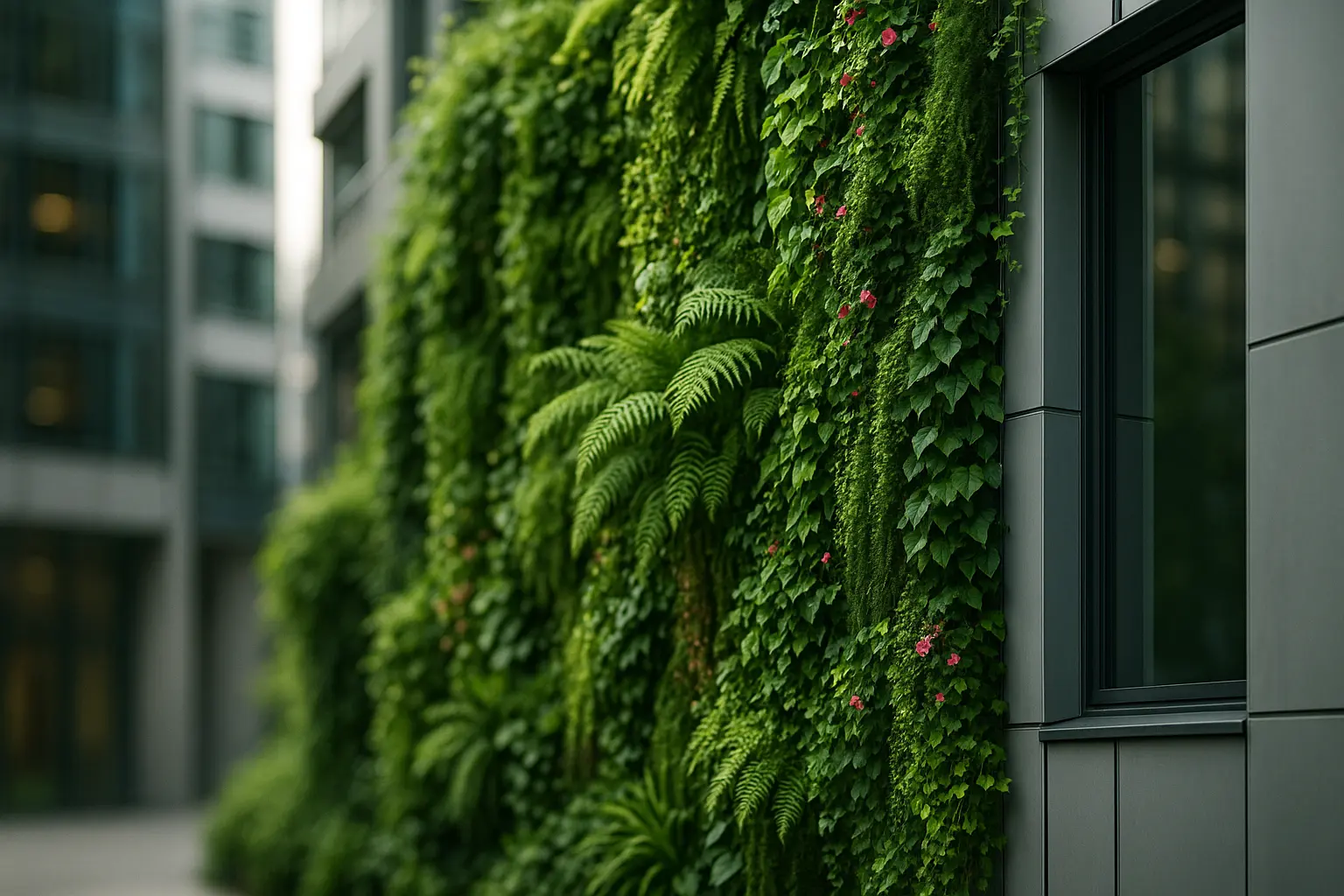
A city apartment rarely comes with a garden attached, but it almost always comes with a wall. Vertical gardens and green walls exist because that wall is, in most buildings, the only unused growing surface left, and turning it into planting space solves a space problem and an air quality problem at the same time.
A vertical garden or green wall is a planted structure grown on a vertical surface instead of a horizontal bed, used to maximize limited space while filtering pollutants and cooling the surrounding air. Field studies on vertical greenery systems have measured surface temperature reductions of up to 13.7°C on living walls during summer, along with measurable drops in fine particulate matter nearby.
- Living walls (soil or substrate-based) and green facades (climbing plants on a support structure) are the two main system types, with different cooling performance.
- Temperature reduction from a well-maintained green wall can reach into the double digits during peak summer heat, depending on climate and irrigation.
- Plant selection depends on light exposure, humidity, and the weight the wall structure can support.
- An irrigation system, whether automated or manual, is what determines long-term survival more than any other design choice.
How much cooling and air quality benefit a green wall actually delivers
The cooling effect comes primarily from evapotranspiration, water evaporating from soil and leaf surfaces, which draws heat away from the immediate area. Research comparing vertical greenery systems found that living walls achieved surface temperature reductions of up to 13.7°C, while green facades reached up to 13.1°C, with the exact figure depending heavily on plant density and irrigation. In tropical field measurements, green walls lowered outdoor air temperature by around 3.0°C at the hottest point of the day, a smaller but still meaningful shift for anyone sitting near the wall.
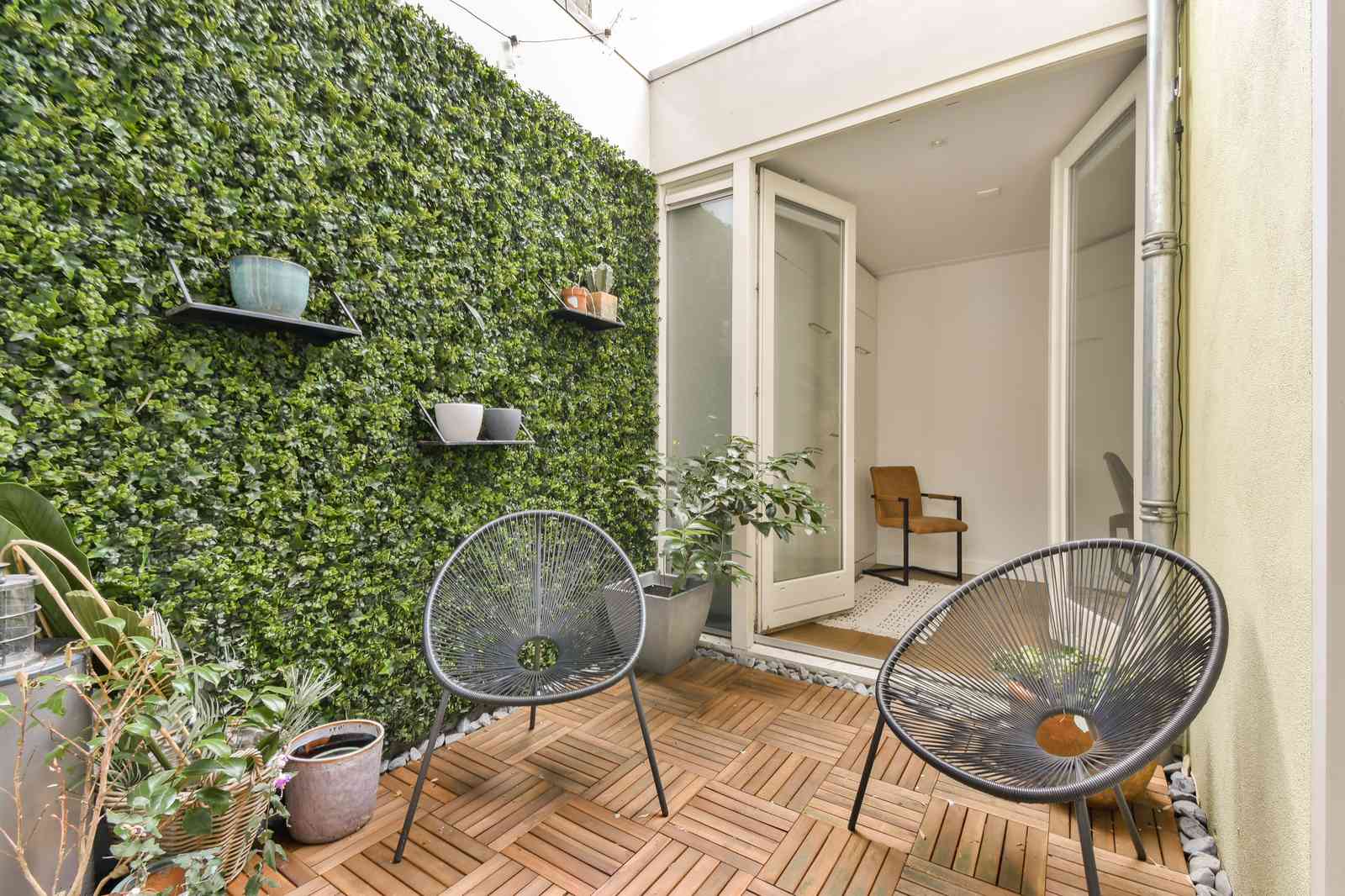
Air quality improves through a similar mechanism. Vertical green facades have been linked to measurable reductions in particulate matter nearby, with one study recording average drops of roughly 1.04 µg/m³ for PM2.5 and 2.05 µg/m³ for PM10 concentrations. These are modest numbers on their own, but they compound across a street lined with several installations rather than a single isolated wall.
| System type | How it’s built | Maintenance level |
|---|---|---|
| Living wall | Modular panels with growing substrate, often with built-in irrigation | Higher, needs regular feeding and pruning |
| Green facade | Climbing plants trained on a trellis or cable support, rooted in ground-level soil | Lower, closer to standard climbing-plant care |
Choosing plants that will actually survive the wall
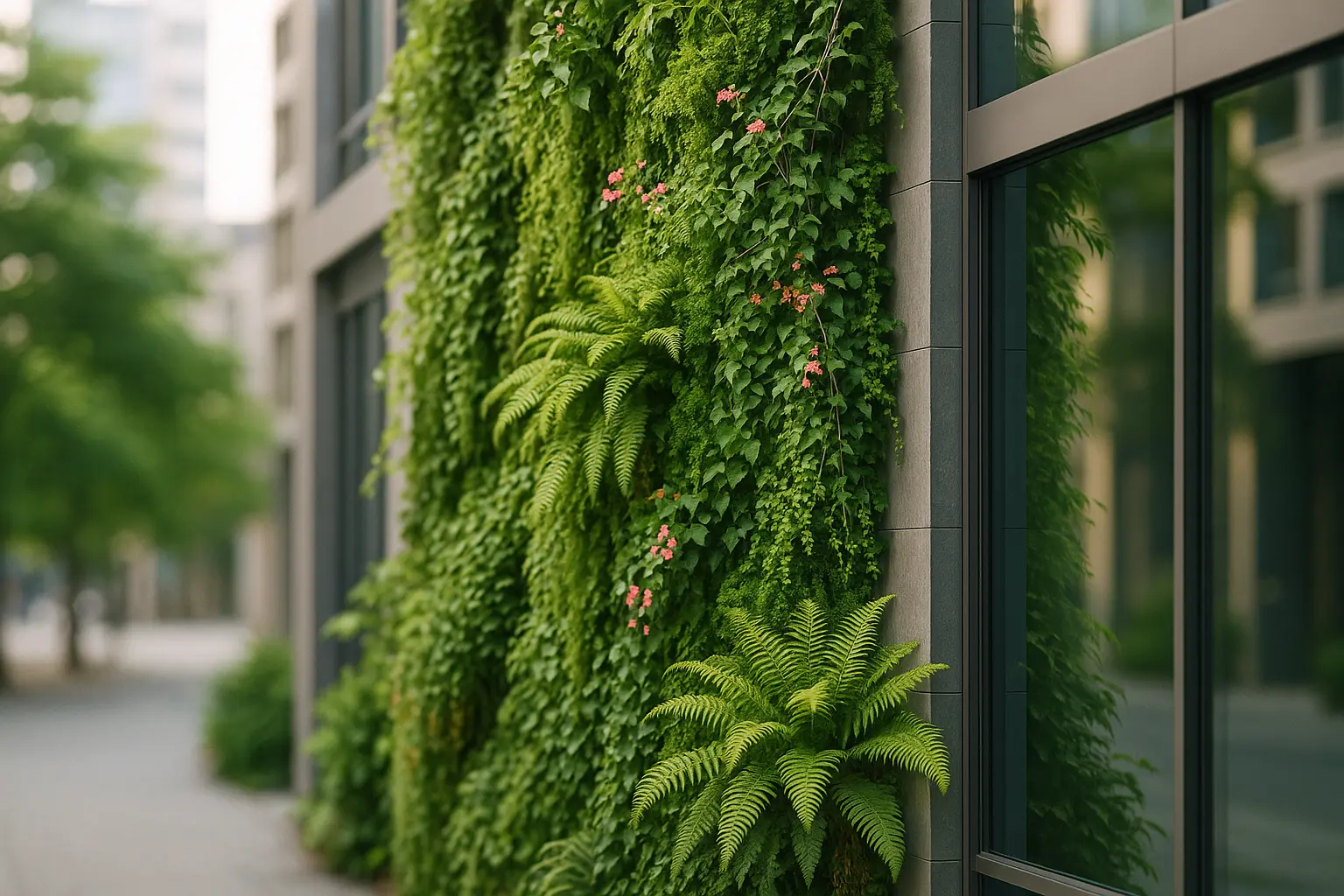
Plant survival on a vertical structure depends far more on light, humidity, and weight than on ordinary garden logic. A wall facing full afternoon sun needs drought-tolerant species, while a shaded interior wall favors ferns and other low-light foliage. Weight is often the limiting factor people overlook: soil-based living wall panels loaded with mature, moisture-retaining plants can add substantial weight per square meter, which is why professional installations always account for structural load before planting rather than after.
Ivy, ferns, and certain succulents remain common choices because they tolerate the inconsistent moisture that even a well-designed wall system produces compared to ground soil. Flowering species can work too, but they generally demand more consistent watering and feeding than foliage plants, which raises the maintenance burden significantly.
Why the irrigation system matters more than the plant choice
Most green wall failures trace back to irrigation, not plant selection. A vertical system dries out faster than a ground bed because gravity pulls water down and away from the upper sections continuously. Sensor-based drip irrigation, timed to the specific substrate and plant mix, solves this more reliably than manual watering, which tends to either underwater the top of the wall or overwater the bottom.
Substrate choice compounds this problem or eases it. A lightweight, high-retention growing medium holds moisture longer between watering cycles than standard potting soil, which reduces how often the irrigation system needs to run and lowers the risk of the upper rows drying out between cycles. Seasonal adjustment matters as well: a schedule set for summer heat will overwater the same wall once autumn temperatures and lower light levels reduce how much water the plants actually use, so the system needs periodic recalibration rather than a single fixed setting left unchanged year-round.
For anyone working with a genuinely small footprint, a green wall is often paired with other space-saving strategies rather than used alone. Squeezing genuine growing space out of a balcony or patio usually means combining a vertical structure with container planting at ground level, rather than relying on the wall to do all the work.
The sustainability argument extends beyond a single installation, too. Recycled framing materials, native or regionally adapted plant choices, and habitat value for urban insects all feed into the wider biodiversity case for green infrastructure in cities, which is increasingly part of how municipalities evaluate whether to approve or subsidize these installations.
FAQ
Can a green wall be installed on any exterior surface?
Not without a structural check first. The wall needs to support the combined weight of the panel system, growing substrate, water, and mature plants, which can be significant for soil-based living walls in particular.
How often does a green wall need watering?
Most systems use automated drip irrigation running daily or every other day, since vertical structures dry out faster than ground-level beds. Manual watering is possible on smaller installations but requires close attention to avoid uneven moisture.
Do green walls work in shaded, low-light locations?
Yes, provided the plant selection matches the light level. Ferns and other shade-tolerant foliage species are commonly used on walls that receive limited direct sun.
Is the cooling effect of a green wall noticeable indoors as well as outdoors?
Interior walls contribute mainly to humidity regulation and air filtration rather than significant cooling. The larger temperature reductions measured in research relate mostly to exterior facades and their effect on surrounding outdoor air and building surface temperature.
Published: July 29, 2026. Last updated: July 29, 2026.
Sources: peer-reviewed field studies on vertical greenery systems and urban heat island mitigation (ScienceDirect, MDPI Sustainability and Buildings journals).