
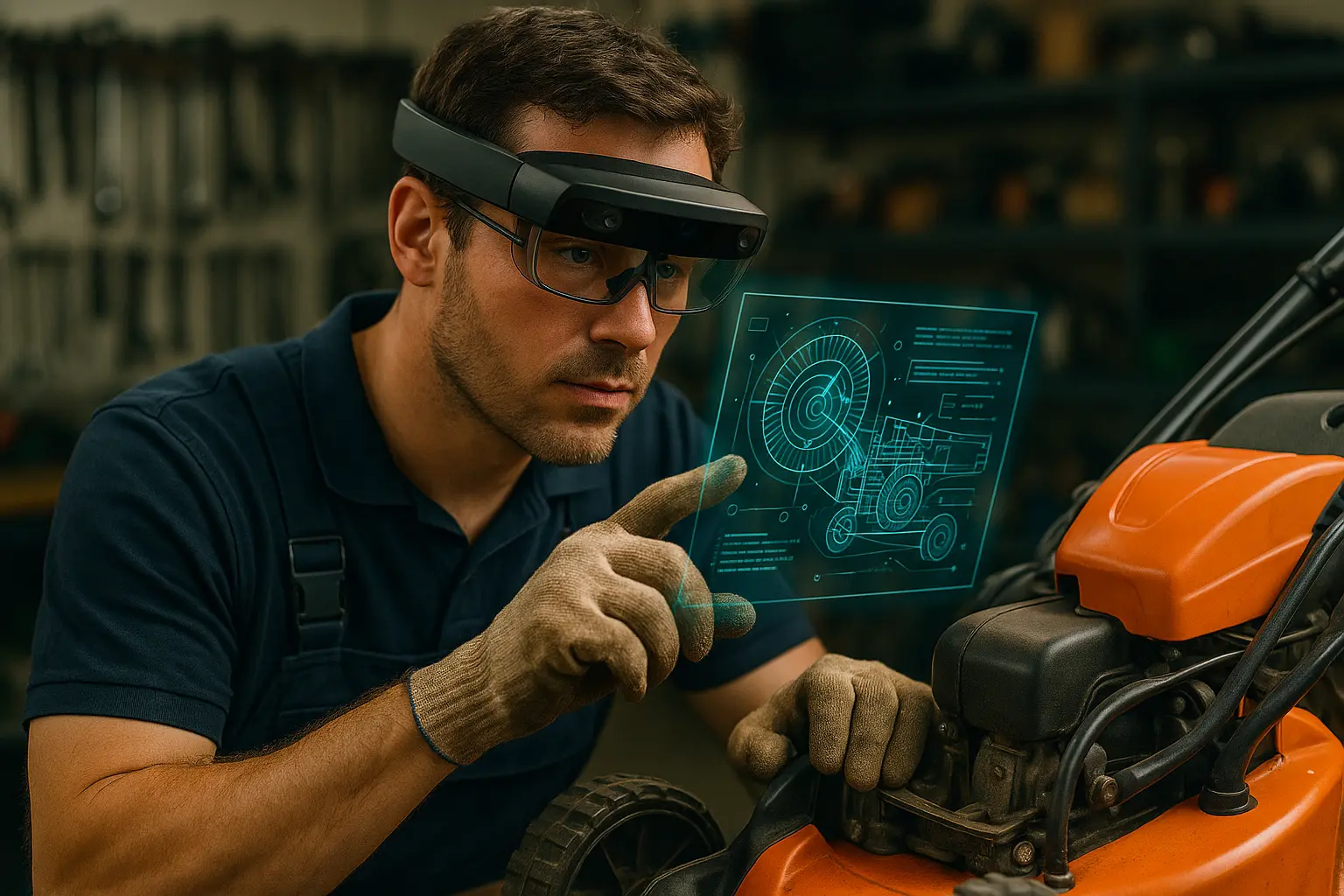
A technician crouches beside a commercial mower that will not start, phone propped against the deck, following a step-by-step overlay that highlights the exact fuel line to check first. No manual, no phone call to a supplier’s help desk, just a guided sequence appearing directly on the part in front of them. That scene, once a novelty, is becoming a normal part of equipment servicing for landscaping and grounds-care fleets.
Augmented reality (AR) maintenance overlays digital instructions, diagrams, or live data directly onto a physical machine through a smartphone, tablet, or AR headset, guiding a technician through repair or servicing steps in real time. Industrial benchmarking from 2025 documents a 32% average improvement in task completion time and a 40% reduction in procedural errors when AR-guided instructions replace paper manuals (PTC industrial AR benchmark, 2025). Adoption in landscaping-specific equipment servicing is still early relative to broader industrial maintenance.
At a glance:
- AR overlays step-by-step repair guidance directly onto the machine being serviced
- Documented gains: faster task completion, fewer procedural errors industry-wide
- Remote training is arguably the strongest near-term use case for smaller landscaping businesses
- A smartphone is often enough; dedicated AR glasses remain a smaller, pricier niche
What AR maintenance actually looks like on landscaping equipment
In practice, a technician points a device at the machine and the app recognizes the model, then overlays arrows, labels, or animated instructions showing which bolt to loosen or which sensor to test next. For a mower, trimmer, or small excavator, this replaces flipping through a printed manual or scrolling a PDF while covered in grease. Some systems also let the technician capture photos or short videos automatically as they work, building a documented repair history without extra paperwork afterward.

The productivity numbers, and what they actually cover
| Metric | Reported improvement | Source context |
|---|---|---|
| Task completion time | 32% faster on average | PTC industrial AR benchmark, 2025 |
| Procedural error rate | 40% reduction | Same 2025 industrial benchmark |
| Training-related error reduction | 15% fewer errors | Reported industrial AR training deployment |
These figures come from broader industrial maintenance settings, not landscaping-specific studies, which have not been published at comparable scale. Treat them as a credible directional signal for what AR can do to a repair workflow, not a guaranteed outcome for a specific mower fleet.
Remote training: the use case that fits smaller crews best
Not every landscaping business can send a junior technician to a manufacturer’s training center for a week. AR-based remote training lets that technician practice a repair sequence through a simulated overlay, repeating the steps as many times as needed before touching real equipment. For a business spread across multiple job sites, or in a rural area far from a dealer’s service department, this closes a real skills gap without the cost of travel or a dedicated instructor on-site.
Smartphone versus dedicated AR glasses
A smartphone or tablet is sufficient for most current AR maintenance applications, and roughly three-quarters of new AR maintenance programs are deployed this way specifically because it avoids extra hardware cost. Dedicated AR glasses offer hands-free convenience, useful when a technician needs both hands on a tool, but they add upfront cost and a learning curve that many small landscaping operations have not yet found worth the investment. For most crews servicing mowers and trimmers, a phone-based app remains the more realistic entry point in 2025.
Once a fleet is already generating usable data through AR-guided servicing, that same data pairs naturally with onboard sensors that catch a failure before it happens, since both approaches rely on flagging a problem before it becomes a breakdown mid-job. For teams building a training program from scratch, virtual reality modules used to train machine operators cover a related but distinct need: operating a machine safely, rather than repairing it.
FAQ
Do I need expensive smart glasses to use AR for equipment repair?
No. A smartphone or tablet handles most current AR maintenance applications, which is why it accounts for the large majority of new deployments.
Does AR replace the need for a trained technician?
No, it supports one. AR guides a technician through a repair sequence more accurately and quickly, but judgment on complex or unfamiliar faults still rests with the person doing the work.
What is the main challenge in adopting AR maintenance for a small landscaping business?
Building or licensing digital content that matches the exact equipment models in the fleet, plus the upfront setup cost, tends to matter more than the technology itself.
Is AR maintenance widely used in landscaping today?
It is used more broadly in industrial maintenance settings. Landscaping-specific adoption is growing but remains an early-stage application rather than an industry standard as of 2025.
AR will not turn a novice into an expert overnight, but for a landscaping business managing a growing equipment fleet, it closes the gap between a printed manual nobody reads on-site and a technician who has memorized every model by heart. Starting with a phone-based app on the machines that break down most often is a reasonable, low-risk way to test whether the documented industrial gains translate to a specific fleet.
Sources: PTC industrial AR benchmark, 2025; reported industrial AR training deployment data, 2025; industry analysis of mobile AR hardware deployment share, 2025.