
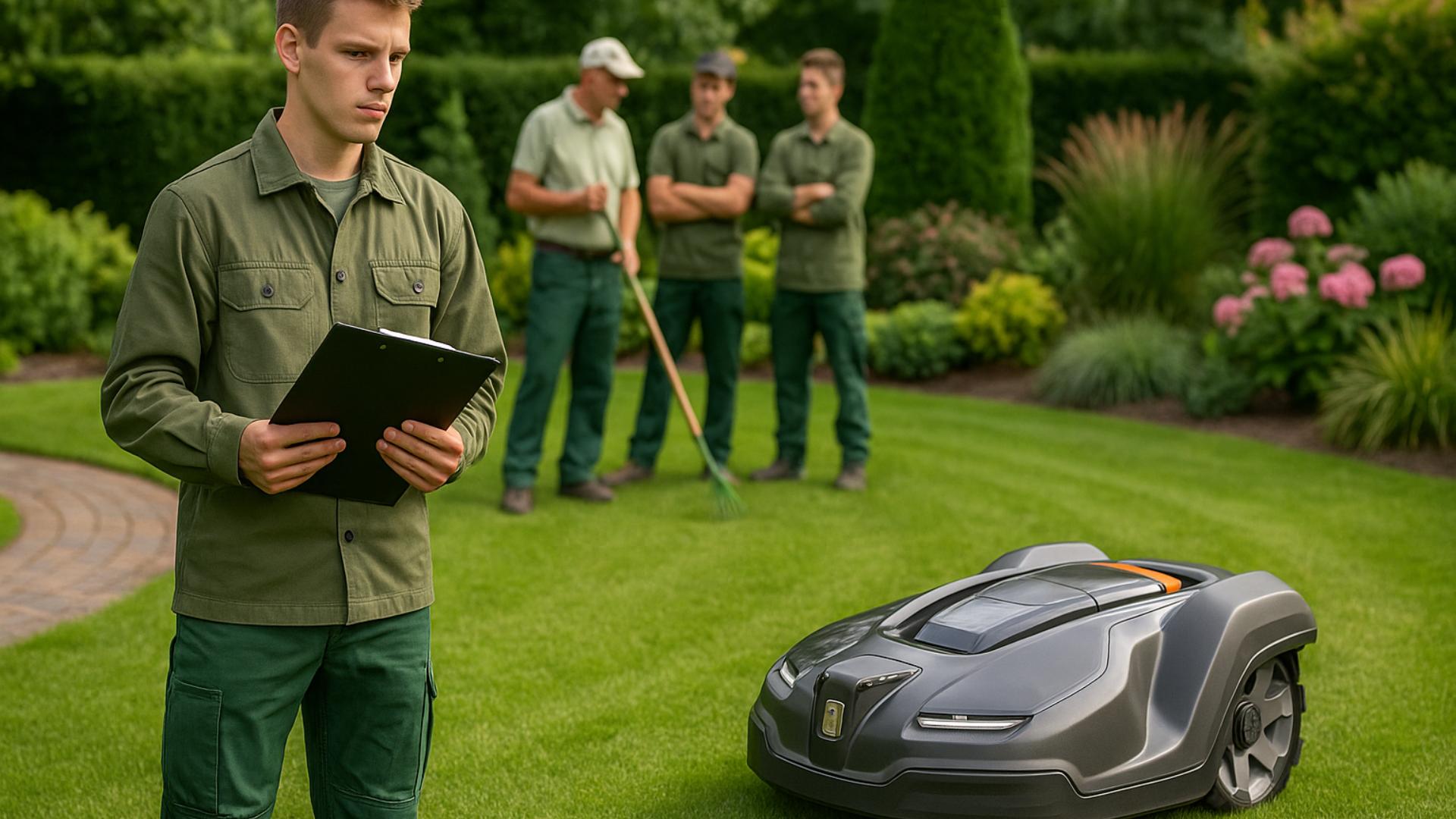
The landscape services sector employs more than 1.4 million people in the United States, and at the same time, 54% of contractors name recruiting and retaining staff as their single biggest business risk in 2026. That combination, a large workforce and a persistent labor gap, sits awkwardly against the usual automation narrative of robots quietly replacing human jobs. In this sector, the more complicated truth deserves a closer look before anyone draws easy conclusions.
Automating manual landscaping tasks raises real ethical and social questions even in a labor-short market, because the jobs being automated and the jobs being created do not always sit with the same workers, at the same pay level, or in the same communities. Robotic mowers and automated irrigation reduce demand for entry-level manual labor while creating new, often better-paid roles in equipment supervision and maintenance, a shift that does not automatically benefit the people displaced from the roles it replaces.
In brief:
- The sector’s labor shortage means automation is currently filling gaps more than eliminating existing jobs outright, but that balance is not guaranteed to hold as the technology matures.
- New roles created by automation (equipment supervision, maintenance, data monitoring) tend to require different skills and command different pay than the manual roles they sit alongside.
- Smaller landscaping businesses face a real access gap: advanced equipment carries a cost that larger firms absorb more easily.
- Ethical practice means transparent communication with existing staff about automation plans, not just a focus on client-facing efficiency gains.
Why automation looks different in a labor-short sector
In most industries, automation debates center on job losses. In landscaping today, the more immediate effect is filling roles nobody was applying for in the first place. With 72% of business owners citing labor availability and retention as their biggest barrier to growth according to Aspire’s 2025 industry data, robotic mowers and automated irrigation are, in the near term, mostly covering gaps left by an already understaffed workforce rather than actively displacing workers from full crews.

This does not make the ethical question disappear, it changes its shape. The relevant concern shifts from “will this take someone’s job today” toward “what happens to entry-level opportunities for new workers once automation becomes the default rather than the exception.”
Who benefits from the new roles automation creates
Roles like fleet supervision, sensor troubleshooting, and equipment maintenance tend to pay more and require more training than the manual mowing or trimming positions they sit alongside. That is a genuine improvement for workers who make the transition successfully. It is also a real barrier for workers who lack access to that training, whether due to cost, language, location, or simply an employer that has not invested in reskilling programs.
A landscaping company that automates without a clear plan for retraining its existing crew risks creating exactly the disparity critics of automation warn about: new, better roles at the top, and fewer entry points at the bottom for the next generation of workers trying to get into the trade.
The access gap between large firms and small operators
Advanced automated equipment carries a cost that scales poorly for small businesses. A large commercial landscaping firm can spread the cost of a robotic mower fleet or sensor-based irrigation system across dozens of contracts, while a two-person operation serving a residential neighborhood often cannot justify the same investment. This creates a competitive gap that has nothing to do with the quality of the work either business delivers, and everything to do with access to capital.
Industry associations and equipment financing programs have started addressing this through leasing models and shared-equipment arrangements, though these remain patchy rather than standard across the sector as of 2026.
What responsible adoption looks like in practice
The clearest ethical baseline is transparent communication with existing staff before automation is introduced, not after. Workers who understand which tasks are being automated, why, and what retraining paths exist tend to adapt with far less friction than those who discover a robotic mower has replaced part of their route without warning.
Beyond communication, businesses that invest in retraining their own crews rather than simply hiring new, differently skilled staff tend to preserve institutional knowledge, the plant care judgment and client relationships built over years, that no automated system replicates.
FAQ
Is automation currently causing net job losses in landscaping?
Not at an aggregate level in a sector facing a documented labor shortage, but the effect is uneven: some entry-level manual roles are shrinking even as supervisory and technical roles grow.
Do small landscaping businesses have a realistic path to affording automation?
Leasing and shared-equipment programs are emerging as options, though they are not yet widely standardized, which keeps a real cost gap between small and large operators for now.
What should a landscaping business tell its crew before introducing automated equipment?
A clear explanation of which specific tasks are changing, what retraining is available, and what the timeline looks like, communicated before the equipment arrives rather than after.
Are there regulations governing how automation should be introduced to a workforce?
Broad labor law applies as it would to any workplace change, but there is no landscaping-specific regulation dedicated to automation transitions as of 2026, leaving most of this to individual business practice.
Automation in this sector is not a simple story of machines replacing people, the labor shortage complicates that narrative considerably. What remains true regardless is that the transition creates winners and people left behind, and the difference between the two often comes down to whether a business treated retraining as a genuine investment or an afterthought. That question connects directly to roles automation has already generated across the industry, and to the safety rules now governing autonomous equipment, which shape how responsibly these machines can be deployed around a workforce still adapting to them.
Sources: Aspire, “Top Landscaping Industry Statistics” (2025) and 2026 Commercial Landscape Industry Report; NALP, landscape industry statistics.
Last updated: July 29, 2026.