
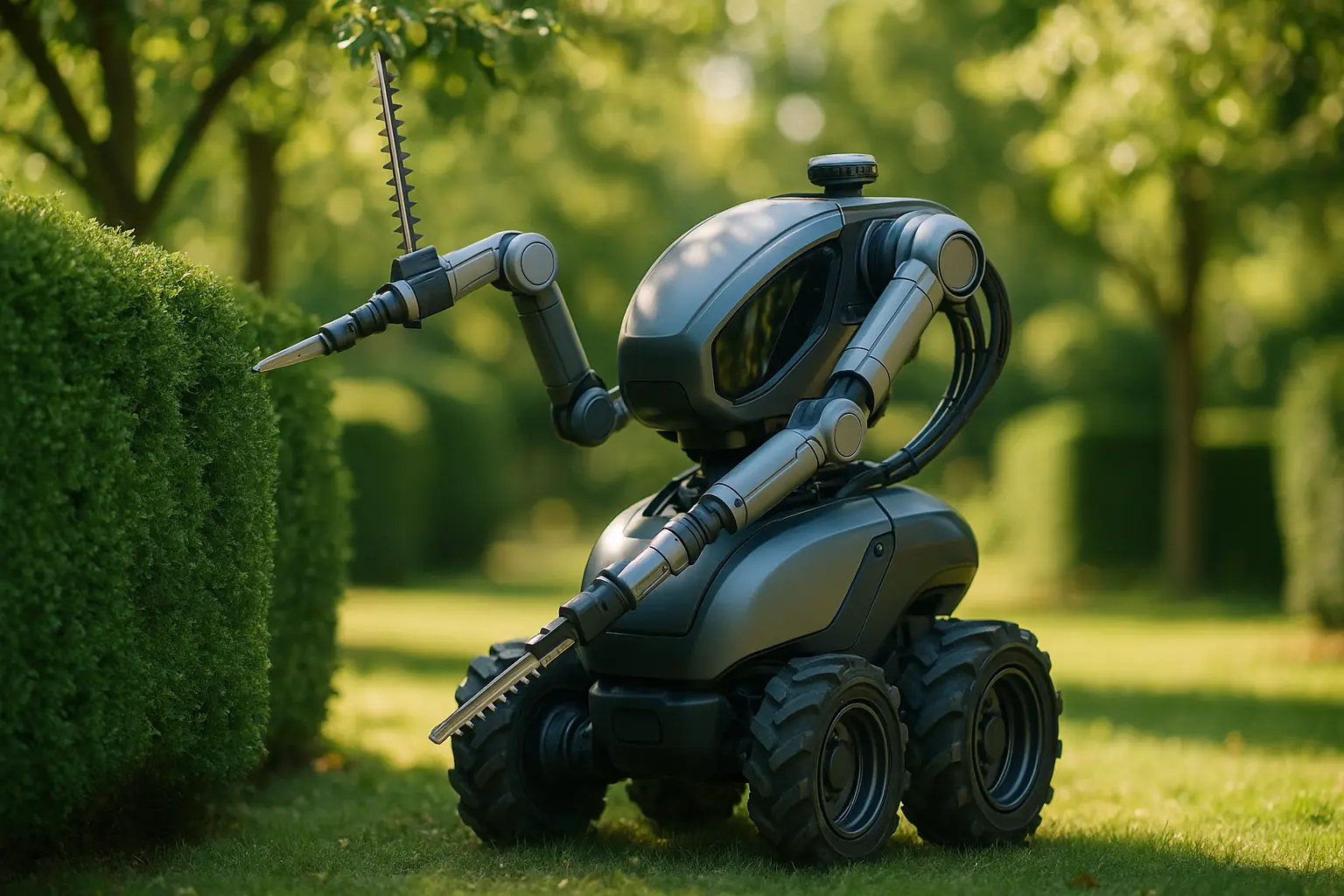
No, a robot cannot yet walk into a mature garden and prune a hedge or a fruit tree with the judgment of an experienced arborist. That correction matters because footage of research prototypes circulates online in ways that make the technology look further along than it actually is. What genuinely exists today sits somewhere between promising laboratory results and a handful of narrow commercial applications, not the fully autonomous trimming crews sometimes implied by press coverage.
Autonomous machines for tree and hedge trimming currently operate reliably only on simple, repetitive cuts in structured environments, such as vineyard spur-pruning, while complex, judgment-based trimming on irregular trees and hedges remains a research-stage capability as of 2025. The gap between the two is precision: a robot can execute a pre-mapped cut with consistency, but deciding which branch to remove for the long-term health of an unfamiliar tree is a different, much harder problem.
Where things stand right now:
- Simple, repetitive cuts (vineyard spur-pruning) already work in controlled field tests
- Complex, judgment-based trimming on trees and hedges remains largely a research problem
- Manual pruning still represents up to 25% of annual labor costs in fruit production, which is the real economic driver behind this research
- LiDAR and 3D mapping are the core technologies making any of this possible
What is commercially real today, and what is still lab-only
| Task | Current status | Notes |
|---|---|---|
| Vineyard spur-pruning | Research prototypes field-tested | Not yet a purchasable commercial product |
| Orchard tree pruning (apple, cherry) | Active research, prototype stage | Uses LiDAR-based 3D branch mapping |
| Ornamental hedge shaping | Not yet demonstrated at research scale | Irregular shapes are harder than orchard rows |
| Robotic mowing | Mature, widely commercialized | A much simpler task by comparison |
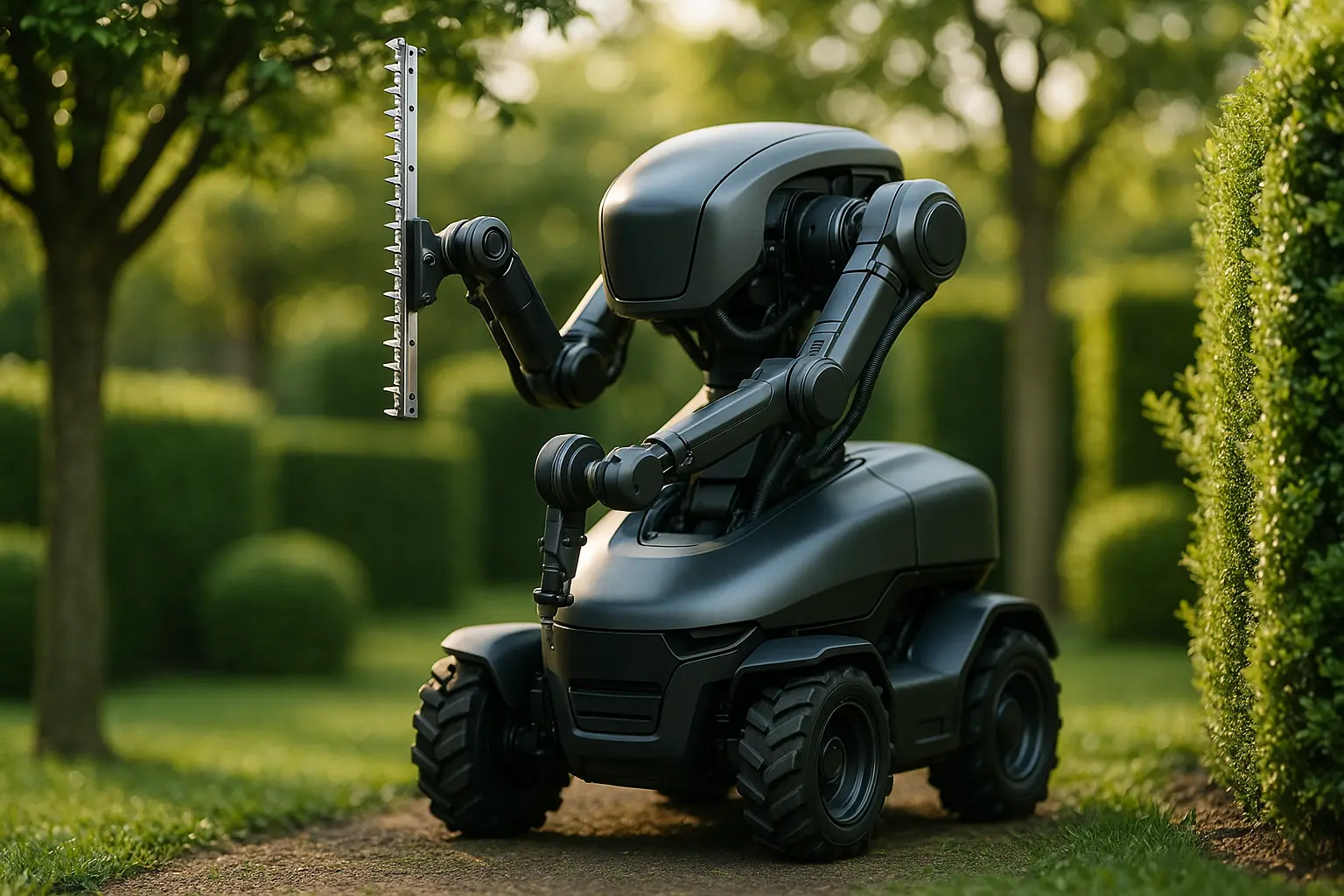
What the research numbers actually say
A research prototype tested in vineyard conditions completed spur-pruning of a full row of vines from both sides in 213 seconds per vine, with a total pruning accuracy of 87%, according to a 2025 review of autonomous robotic pruning published in a peer-reviewed agricultural technology journal. Field tests of similar systems in a commercial vineyard reported a reduction in pruning variability compared with mechanical pre-pruning trials, which matters because consistent cuts affect the following year’s yield.
An 87% accuracy rate sounds strong until it is measured against what a human pruner does: a missed or wrong cut on 13 out of every 100 vines is not yet acceptable for unsupervised commercial deployment, which is exactly why these systems remain research prototypes rather than products a landscaping company can order today.
Why trimming is a harder robotics problem than mowing
A lawn is a flat, mostly predictable surface. A tree is a three-dimensional, irregular structure that changes shape every season, and the “right” cut depends on the species, the plant’s health, and aesthetic intent, not just geometry. Researchers rely on LiDAR sensors and cameras to build a three-dimensional digital copy of each tree before any cutting decision is made, a process sometimes called branch reconstruction. Even with that mapping, the algorithm still has to correctly identify which branches are structural, which are diseased, and which are simply overgrown, three judgments that experienced arborists make almost instinctively and that remain genuinely difficult to encode reliably in software.
The labor economics pushing this research forward
Manual pruning represents up to 25% of annual labor costs in fruit production, according to agricultural economics research, which is the real reason universities and equipment makers keep investing in this technology despite the accuracy gap. Rising labor costs and a declining number of young workers entering farming and landscaping trades add further pressure. That economic case is strong enough that continued investment is very likely, but it does not shorten the technical timeline for solving the judgment problem described above.
What still has to change before this reaches a landscaping crew
Three specific gaps separate today’s research prototypes from a machine a landscaping business could actually buy. The first is accuracy at scale: an 87% success rate on a single vine row is not the same as 87% sustained across thousands of plants with no supervision, and closing that remaining gap has historically taken years rather than months in agricultural robotics. The second is generalization across plant types, since a model trained on grapevines does not automatically transfer to a boxwood hedge or an ornamental maple, each of which has its own branching pattern and pruning logic to learn from scratch. The third is liability and insurance, an unglamorous but real barrier: a company deploying an autonomous cutting tool on a client’s mature tree needs clarity on who is responsible if the machine makes a damaging cut, and that framework is still largely undefined for this specific application.
None of these three gaps are unsolvable. They are simply the reason experienced observers in agricultural robotics describe a multi-year runway rather than an imminent product launch, even as the underlying research keeps producing better results year over year.
FAQ
Can I buy an autonomous tree-pruning robot today?
Not for general landscaping use. What exists are research prototypes tested in structured settings like vineyards, not a commercial product built for irregular trees and hedges on a typical residential or commercial property.
Which trimming tasks are closest to real-world use?
Simple, repetitive cuts on structured plantings, such as vineyard rows or uniform hedgerows in commercial nurseries, are the closest to practical deployment because the plant structure is predictable and repeatable.
Why not just use the same robots already used for mowing?
Mowing involves a flat, largely uniform surface. Trimming requires judging a three-dimensional, irregular structure and making a decision about which specific branch to remove, a fundamentally harder perception and reasoning problem for a machine.
Is this technology likely to replace arborists?
Not in the near term. Even optimistic research timelines point toward machines assisting with repetitive cuts under supervision, rather than replacing the judgment-based decisions a trained arborist makes on a mature or valuable tree.
For landscaping businesses watching this space, the more immediately useful technology is farm machinery retrofitted for landscaping-specific jobs, since agricultural pruning research tends to reach landscaping applications only after years of adaptation. In the meantime, multi-purpose machines designed to switch between tasks offer a more realistic automation investment for a crew today than a dedicated autonomous trimmer.
A reasonable prediction, and it remains a prediction rather than a fact: simple, repetitive trimming tasks on structured plantings such as vineyard rows or hedgerows in commercial nurseries will likely see limited commercial deployment before 2030, while fully autonomous, judgment-based pruning of mature ornamental trees remains a much longer research horizon. Anyone selling the opposite claim today is getting ahead of what the published research actually supports.
Sources: 2025 peer-reviewed review of autonomous robotic pruning in orchards and vineyards, ScienceDirect; agricultural economics research on labor cost share of manual pruning in fruit production; OnePlanet Research LiDAR-based orchard mapping project.