
Agriculture accounts for roughly 70% of global freshwater withdrawals, according to FAO figures on water use, which makes irrigation efficiency one of the few places where a single technology change can move a genuinely large number. AI-powered smart irrigation is one of the technologies being tested against that number, and the results so far are promising enough to matter, without being uniform enough to treat as settled.
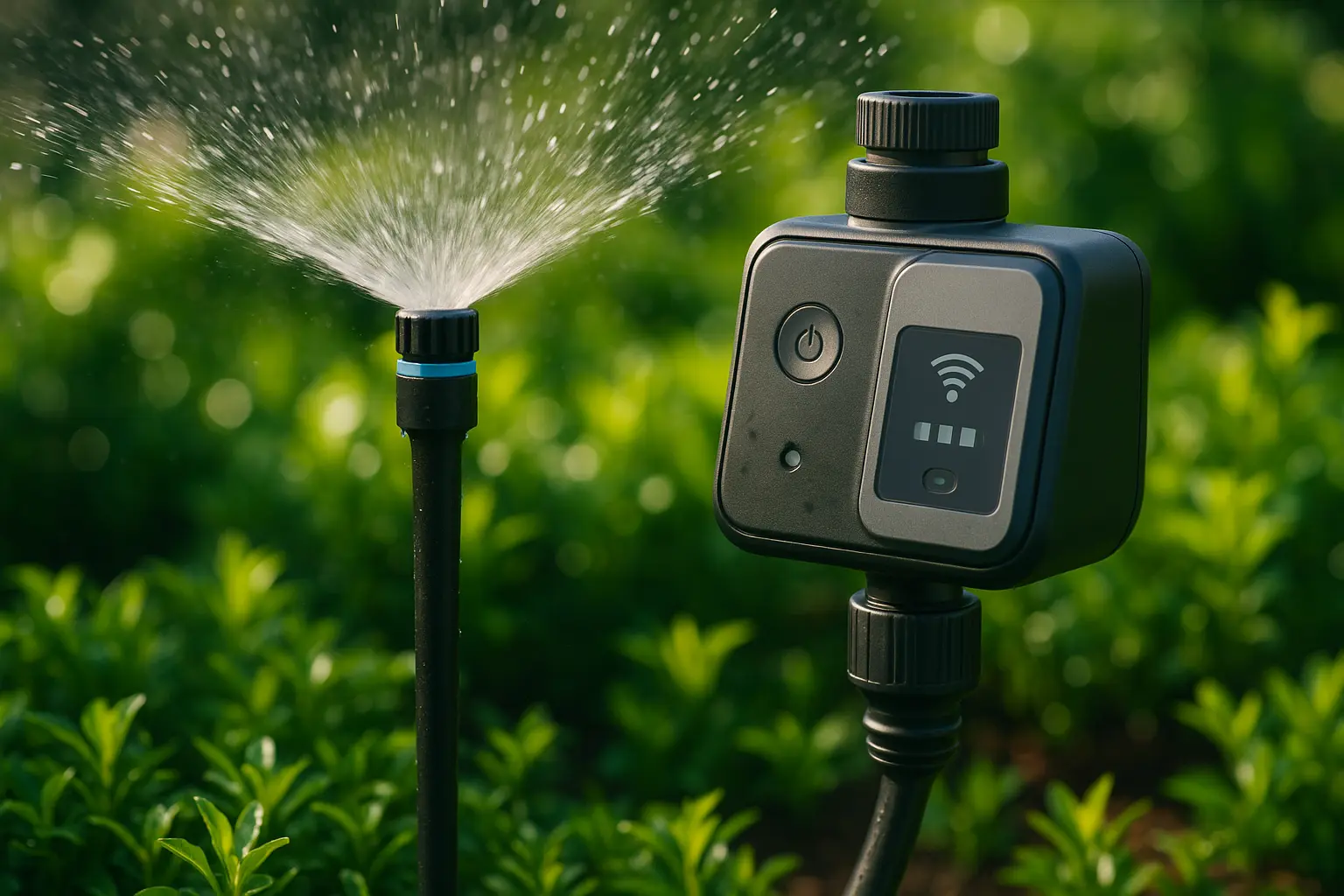
AI-powered smart irrigation systems combine soil moisture sensors, weather data, and machine learning models to calculate exactly how much water a garden or field needs, then deliver it automatically, adjusting in real time rather than following a fixed schedule. The goal is watering based on actual plant and soil conditions instead of a calendar.
In brief:
- Published studies report water savings ranging widely, from around 25% to over 70%, depending on the system, crop, and baseline comparison used.
- These systems rely on a sensor network (soil moisture, temperature, sometimes light) feeding a model that adjusts watering automatically.
- Remote management through smartphone apps is now standard on most commercial and many residential systems.
- Upfront cost and the technical literacy needed to configure these systems remain real barriers, particularly for smaller operations.
How much water these systems actually save
The honest answer is a wide range, not a single number. A case study using Microsoft’s AI-driven irrigation initiative in Andhra Pradesh, India, reported up to 70% water savings alongside a 30% yield increase. Other peer-reviewed research on AI-supported autonomous irrigation found water savings closer to 35% relative to a manual irrigation baseline, while a study of IoT-enabled precision irrigation in Uganda measured savings around 27%. The spread reflects real differences in crop type, climate, baseline irrigation practice, and how “savings” is defined in each study, not inconsistency in the technology itself.

What is consistent across this research is the direction of the effect: every study reviewed found a meaningful reduction in water use compared with manual or fixed-schedule irrigation, none reported an increase.
What sensor data actually drives the watering decision
A typical system pulls readings from soil moisture probes, temperature and humidity sensors, and increasingly, live weather forecast data, then feeds that combined picture into a model trained to predict how much water a specific plant or crop needs before stress sets in. This is a meaningful step beyond older “smart” timers, which simply adjusted a fixed schedule based on a single rain sensor rather than continuously modeling actual soil and plant conditions.
The model’s accuracy depends heavily on sensor placement and calibration. A soil probe placed too close to a drainage point or in an unrepresentative patch of a garden will feed the system bad data, which is why installation quality matters as much as the underlying software.
Where remote management genuinely changes day-to-day operations
Smartphone and web-based control now lets a manager adjust watering schedules across multiple properties from a single interface, which is particularly valuable for landscaping companies and large-scale farms where manual, on-site monitoring of every zone is simply impractical. This is less a novelty feature than a genuine operational shift: a manager can respond to a sudden heatwave forecast across a dozen properties in minutes rather than dispatching staff to check each site individually.
Reported water savings across recent studies
| Study or case | Reported water savings | Context |
|---|---|---|
| Microsoft AI irrigation initiative, Andhra Pradesh | Up to 70% | Alongside a 30% yield increase |
| AI-supported autonomous irrigation case study | Around 35% | Relative to manual irrigation baseline |
| IoT precision irrigation study, Uganda | Around 27% | Smallholder maize farming context |
What still limits wider adoption
Cost remains the most cited barrier, particularly for smaller farms and residential gardens where the price of a full sensor network and controller can be hard to justify against the water savings alone. Technical literacy is the second barrier: configuring a system correctly, calibrating sensors, and interpreting the data it produces requires a learning curve that not every operation has time or staff to absorb without support.
Government incentive programs and partnerships between technology providers and agricultural extension services are beginning to address the cost gap in some regions, though coverage remains inconsistent, and a smaller residential garden owner today largely has to weigh the upfront cost against water savings without that kind of external support. Financing and rental models, where a grower pays a subscription rather than buying sensors and controllers outright, are starting to appear as one workaround, though they remain far from standard practice across the sector as of 2026.
FAQ
Can AI-powered irrigation work for a residential garden, not just a farm?
Yes, scaled-down residential systems exist and are increasingly affordable, though the return on investment is clearer for larger properties with higher baseline water use.
Do these systems require a constant internet connection to function?
Most need connectivity for remote monitoring and cloud-based model updates, though many can continue basic automated watering locally if connectivity drops temporarily.
How accurate are the water savings figures typically advertised?
Figures vary significantly by study and context, from roughly 25% to over 70%. A specific percentage quoted without its source study and baseline comparison should be treated with caution.
What sensors are essential versus optional in a basic setup?
Soil moisture sensing is essential. Temperature, humidity, and weather-forecast integration add refinement but a functional system can operate on soil moisture data alone.
The technology has moved well past the experimental stage, it is commercially available and backed by a growing body of field research. What buyers should hold onto is that the water-saving figure that matters is the one measured against their own baseline, not the best number found in someone else’s case study. Gardens designed with water conservation in mind from the outset benefit further when rainwater harvesting built into the garden’s design works alongside a smart irrigation controller, and the sensor logic described here is part of a broader shift covered in the wider IoT sensor networks now used in green spaces.
Sources: FAO, global water use in agriculture data; PMC, “Effects of AI-Supported Autonomous Irrigation Systems on Water Efficiency” case study; arXiv, “A Smart IoT Framework for Climate-Resilient Maize Farming in Uganda” (2025); Fanack Water, AI and data analytics for water-smart agriculture.
Last updated: July 29, 2026.