
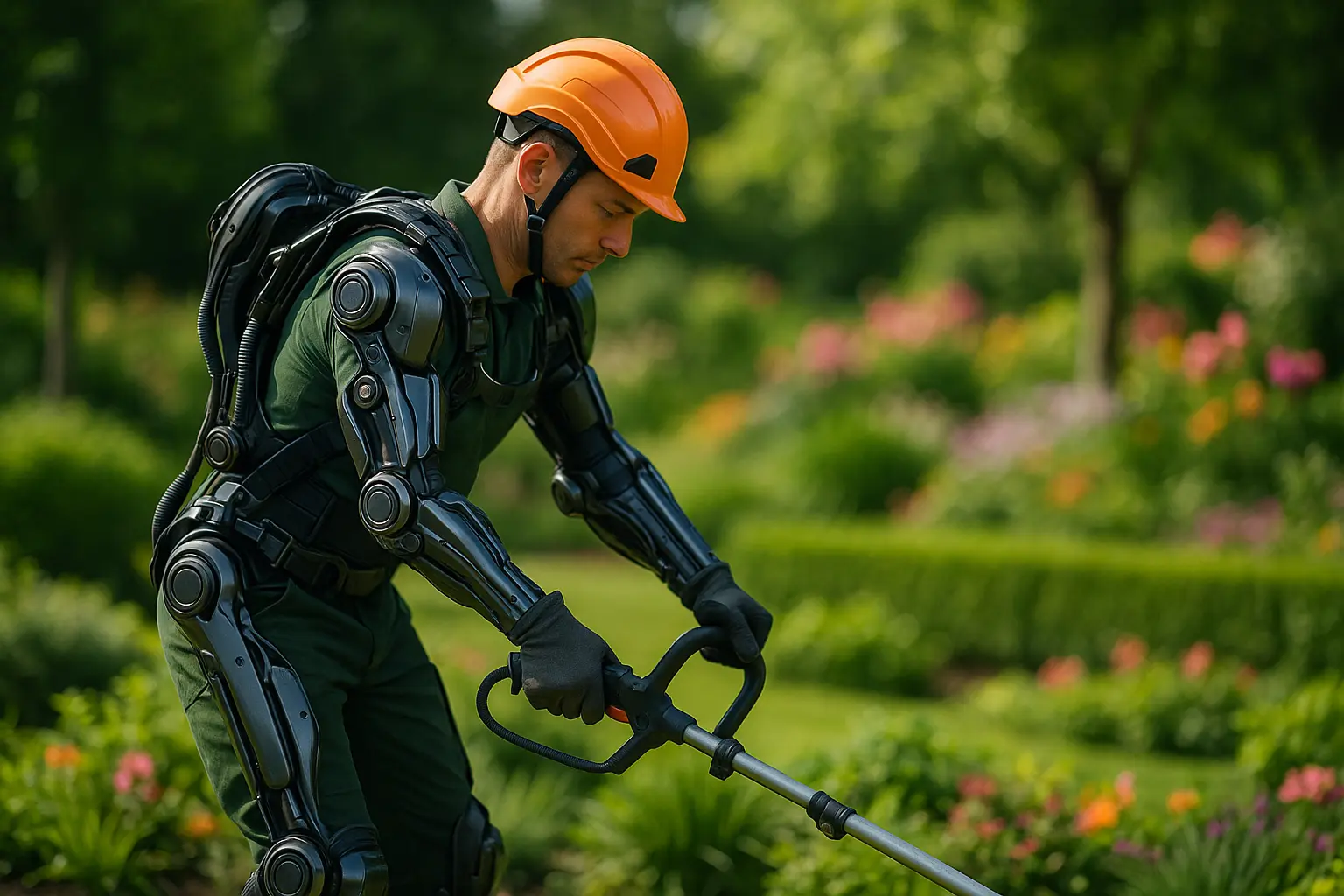
Grounds maintenance workers get hurt on the job at more than twice the rate of the average US employee: 189 injuries per 10,000 full-time workers against 87 across all occupations (Bureau of Labor Statistics). Most of those injuries trace back to the same culprits: repetitive lifting, awkward bending, and hours spent hunched over a trimmer or a wheelbarrow. That is the problem exoskeletons are actually being tested against, not some abstract vision of robot suits.
An exoskeleton for landscape work is a wearable frame, either spring-powered (passive) or motor-driven (active), that redistributes load away from the lower back, shoulders, or knees during repetitive or heavy tasks. Field trials in agriculture and construction, run between 2019 and 2025, report measurable reductions in muscle fatigue and lower-back stress. Adoption in landscaping specifically remains at the pilot stage, not a standard piece of crew equipment yet.
Quick summary:
- Grounds workers face more than double the injury rate of the average worker (BLS)
- Passive exoskeletons use springs, active ones use motors and sensors
- Pilot programs in landscaping and adjacent trades show reduced back strain, but scale is still limited
- Comfort, cost, and task variety remain the main adoption barriers
Passive and active exoskeletons: what separates them
| Type | Power source | Best suited task | Typical drawback |
|---|---|---|---|
| Passive back support | Springs and mechanical tension | Repetitive lifting, bending for planting | Fixed support level, no adaptation |
| Passive shoulder support | Springs | Overhead pruning, hedge trimming | Can restrict full arm rotation |
| Active motorized | Battery-powered motors and sensors | Variable-intensity heavy lifting | Higher cost, added weight, battery life |
What multi-year pilot trials actually found
Multi-week pilot trials among German vegetable farms and French vineyards, run between 2019 and 2022, tested exoskeleton adoption directly against the physical demands of agricultural work. The results pointed to reduced muscle fatigue where the task matched the device, but also to something the marketing rarely mentions: workers dropped devices that did not fit their specific movements, regardless of the measured biomechanical benefit.
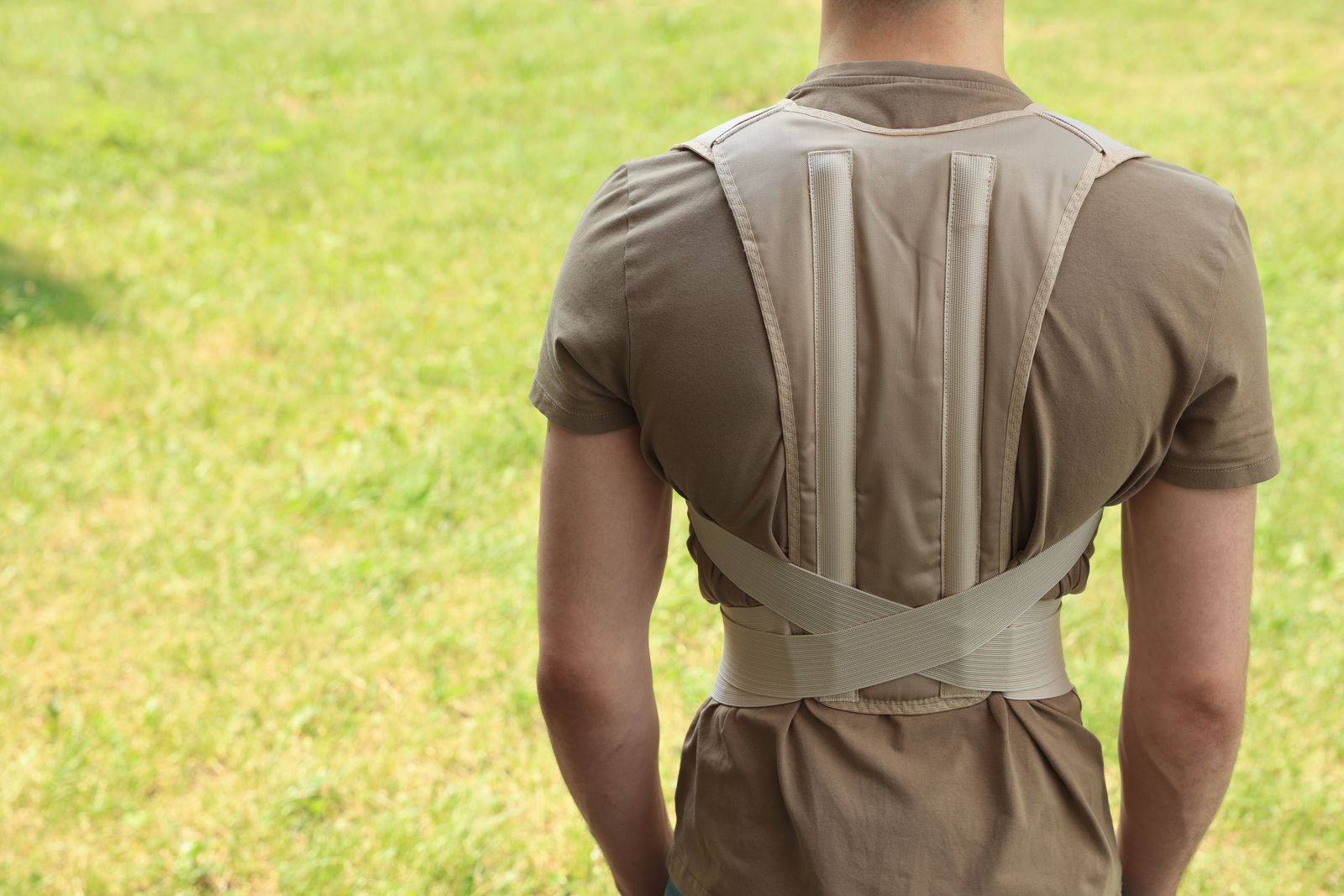
A separate review of upper-limb occupational exoskeletons, published in 2025, reaches a similar conclusion for the broader outdoor-work sector: the technology reduces strain under lab and short-trial conditions, but sustained daily acceptance depends on fit, task match, and comfort more than on the raw performance numbers. Landscaping-specific pilot programs, tested on tasks like tree trimming and stonework, follow the same pattern, showing decreased lower-back stress and improved endurance during the trial period rather than industry-wide rollout.
Why this is still a pilot technology, not standard kit
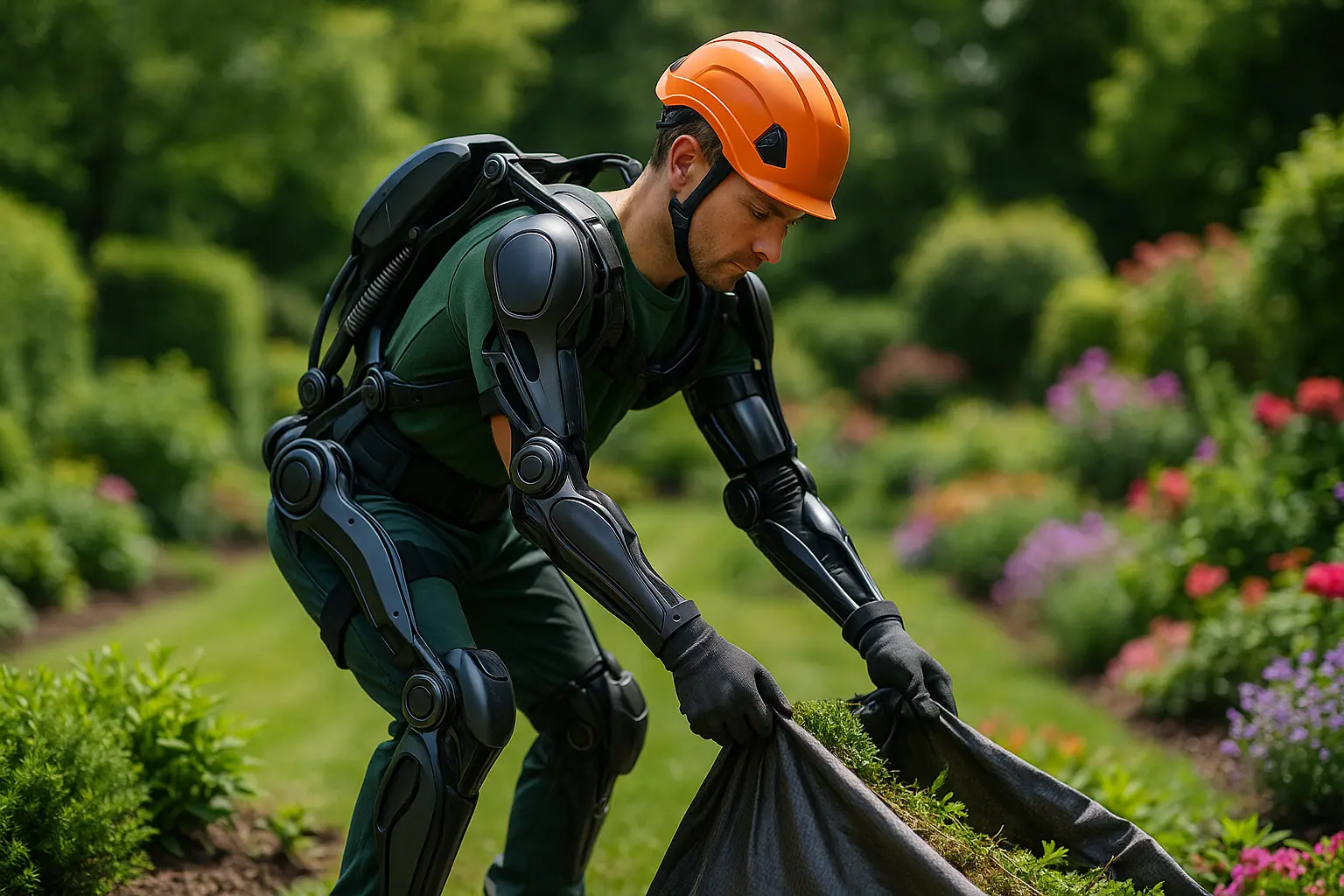
A 2023 case study review on exoskeleton non-acceptance in agriculture found that devices failed to stick around not because the biomechanics were wrong, but because they did not match the actual variety of tasks a field or landscaping worker performs in a single day. A back-support frame tuned for lifting mulch bags can get in the way of climbing a ladder ten minutes later.
This matters for how a landscaping business should read the marketing around exoskeletons in 2025. No major manufacturer currently offers a device purpose-built and validated at scale for the full range of landscaping tasks (mowing, pruning, digging, hauling) in one unit. What exists today are task-specific devices, tested in pilot programs, that suit one or two recurring motions well.
The devices that stayed in daily use were the ones workers barely noticed by lunchtime, not the ones with the highest lab scores.
Cost and practical adoption for a landscaping crew
Passive units generally cost less and require no charging, which makes them a reasonable first trial for a crew leader who wants to test acceptance before committing budget. Active, motorized units cost considerably more and add weight from batteries, a tradeoff worth testing on one or two employees before outfitting an entire team. Training also matters: workers need a short adjustment period to learn how to move naturally while wearing the frame, and skipping that step is a common reason pilots fail early.
The broader question of how automation reshapes physical roles on a crew, not just the tools themselves, ties into the retraining question automation raises for landscaping crews. On the mechanical side, planting machines built to spare workers repetitive strain address some of the same lifting tasks from a different angle, by removing the human motion entirely rather than supporting it.
Insurance and liability: the question crew leaders ask first
Before biomechanics, most crew leaders piloting exoskeletons ask a more practical question: does this change what workers’ compensation or equipment insurance covers? Right now, there is no industry-wide standard answer. Some insurers view a documented exoskeleton pilot as a proactive injury-prevention measure that can support a lower claims history over time, while others have not yet built specific underwriting guidance around wearable devices at all. A landscaping business considering a pilot should raise this directly with its insurance provider before rollout, rather than assuming the device automatically changes its liability position.
Maintenance is a related, often overlooked cost. A passive spring-based unit needs periodic inspection for wear on its mechanical joints, and an active motorized unit needs battery management and firmware updates much like any other piece of powered equipment on a truck. Neither cost is large individually, but both belong in the total cost of ownership calculation rather than in the sticker price alone.
FAQ
Are exoskeletons safe for all-day use on a landscaping site?
Modern units are designed to be lightweight and adjustable, but comfort over a full eight-hour shift varies by individual and by task. A short trial period is the only reliable way to know.
Do exoskeletons eliminate the risk of musculoskeletal injury?
No. They reduce strain and redistribute load, which lowers risk, but they do not eliminate it. Proper lifting technique and task rotation remain necessary alongside the device.
Which task should a landscaping business trial first?
Repetitive lifting and bending tasks, such as loading mulch or planting containers, show the clearest documented benefit in current pilot studies compared with more varied tasks.
Is this technology commercially mature in 2025?
Passive back-support units are commercially available and used in adjacent industries like construction. Landscaping-specific deployment remains limited to pilot programs and early adopters rather than widespread industry standard.
Exoskeletons will not fix a landscaping crew’s injury rate overnight, and treating them as a finished, one-size-fits-all solution misreads where the technology actually stands. Trialed on the right task, with the right fit, the current generation of passive devices already gives a measurable edge against the physical wear the job puts on a body over a career.
Sources: US Bureau of Labor Statistics, occupational injury data for grounds maintenance workers; multi-year exoskeleton field pilots in French and German agriculture, 2019-2022; 2025 review of upper-limb occupational exoskeletons; 2023 case study review on exoskeleton implementation challenges in agriculture.