
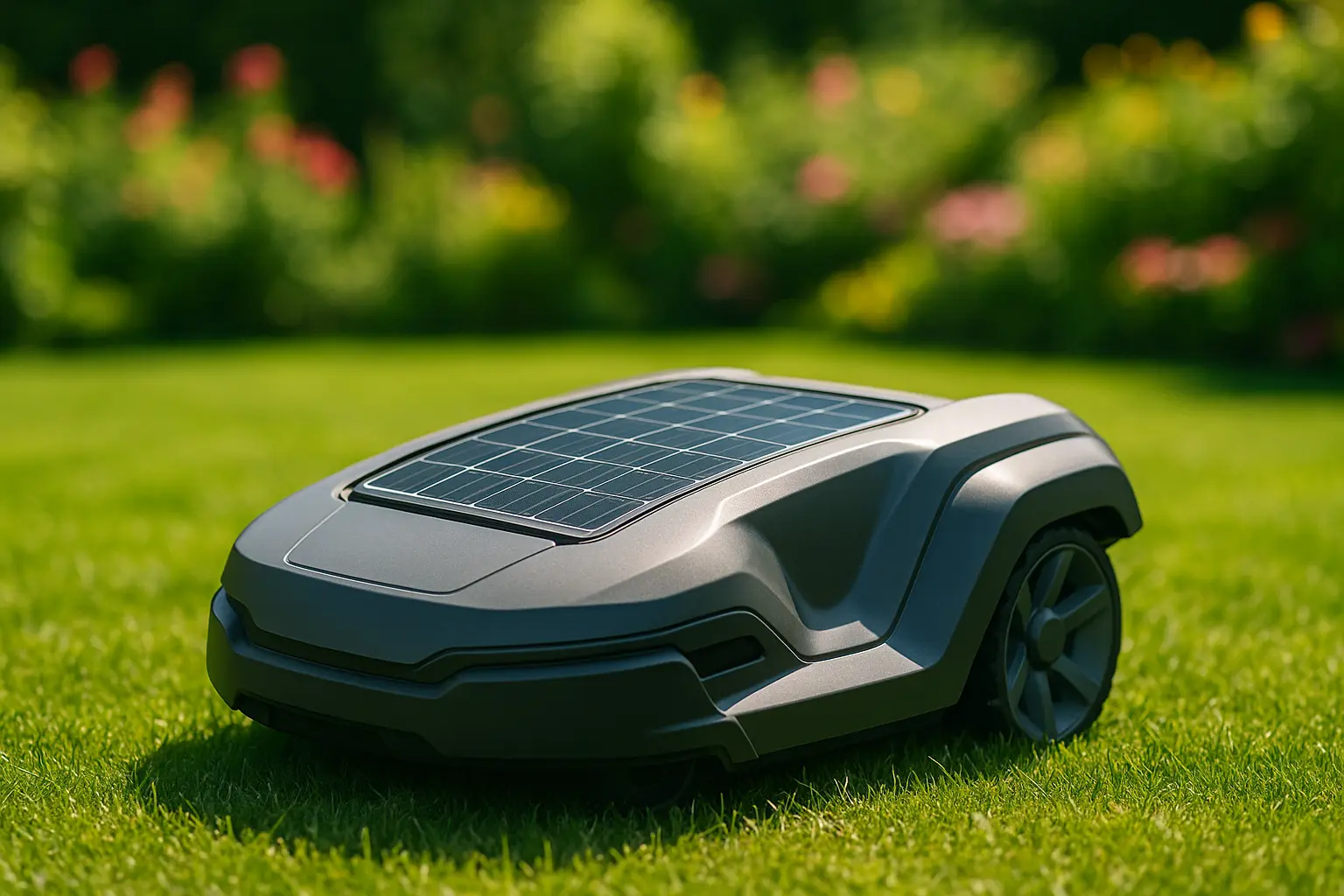
The global robotic lawn mower market was valued at several billion dollars in 2025, with multiple market research firms tracking double-digit annual growth into the 2030s. Behind that figure sits a simpler story: a growing share of those mowers no longer plug into a wall socket at all, relying instead on a small solar panel to keep their batteries topped up between charging-dock visits.
Solar-powered robotic mowers combine a battery-electric cutting deck with photovoltaic panels, either mounted on the mower itself or on its charging station, to extend runtime and reduce how often the machine needs a full mains charge. They cut grass autonomously within a boundary defined by a wire or, on newer models, by GPS and onboard cameras, and they return to a base station when the battery runs low.
In brief:
- Solar panels rarely power the mower directly during cutting, they mainly top up the battery between cycles.
- The robotic lawn mower market was valued between roughly $2.4 billion and $10.5 billion in 2025 depending on the research firm’s methodology and market definition, with all major reports agreeing on strong double-digit growth ahead.
- Labor shortages are cited by market analysts as a direct growth driver alongside battery and navigation improvements.
- Solar assistance works best on open, sun-exposed lawns; shaded or heavily wooded properties see little practical benefit.
How the solar component actually fits into the mowing cycle
The direct answer is that solar power is a supplement, not the primary energy source, for almost every commercially available model. A cutting deck draws far more current than a small integrated panel can supply in real time, so the panel’s real job is trickle-charging the battery while the mower sits docked or, on some designs, while it works in full sun. This distinction matters for buyers who expect a mower that never needs mains electricity: in practice, solar assistance reduces charging frequency and electricity draw, it does not eliminate the need for a charging base.
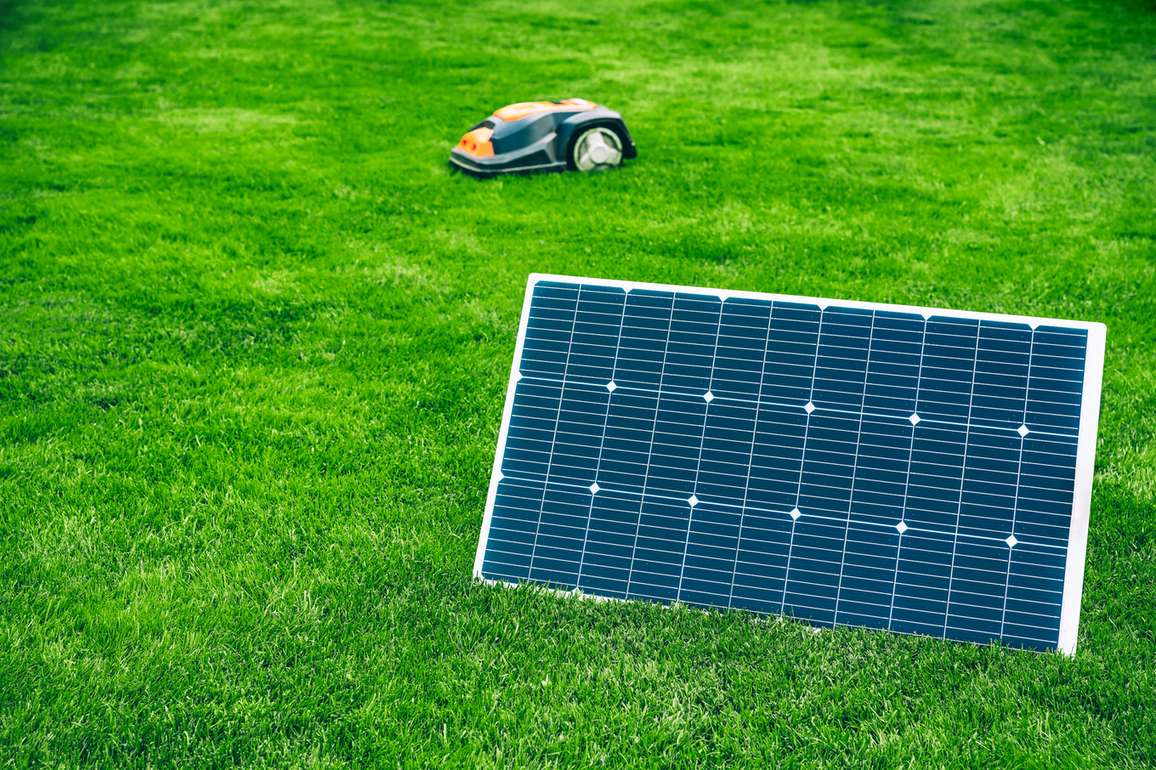
Manufacturers that build panels directly into the charging station rather than the mower’s chassis tend to get a better return on the solar investment, since a stationary panel can be angled for maximum sun exposure without adding weight to a machine that needs to stay light and low for stability on slopes.
What the navigation and safety systems can do today
Current models rely on a mix of boundary wires, GPS positioning, and obstacle sensors to map a lawn and avoid collisions with pets, furniture, or people. Premium models have moved toward wire-free setup using satellite positioning combined with onboard cameras, a genuine improvement over the buried-wire installation that used to be the main barrier to adoption on complex properties.
Obstacle detection has matured enough that most reviewed models stop or reroute reliably around static objects, though manufacturers and independent reviewers both still recommend supervision around small children and pets during a mower’s first weeks in a new yard while its mapping stabilizes.
Where solar assistance makes the most financial sense
The clearest use case is large, open turf areas with consistent sun exposure: golf course fairways, sports fields, and commercial campuses. These sites already run mowing equipment on tight schedules, and any reduction in mains charging cycles translates directly into lower electricity costs and less downtime spent docked.
Residential lawns see a smaller, but still real, benefit. A typical suburban yard mowed a few times a week rarely drains the battery enough for solar top-up to matter much, though owners in sunnier climates report noticeably longer intervals between full mains charges.
Comparing solar-assisted and standard electric robotic mowers
| Factor | Standard electric mower | Solar-assisted mower |
|---|---|---|
| Mains charging frequency | Daily to every few days | Reduced on sunny, open sites |
| Best-fit site | Any residential or commercial lawn | Open turf with strong, regular sun exposure |
| Upfront cost | Lower | Higher, panel adds to unit cost |
| Noise level | Low | Low, no difference from the solar component |
Where the technology still has real limits
Steep slopes, dense shade from mature trees, and irregularly shaped lawns with narrow passages remain the three conditions where even the best-reviewed solar-assisted mowers underperform. Shade is the most relevant limitation for the solar angle specifically: a mower operating under heavy tree cover gets essentially none of the intended battery benefit, since the panel needs direct or near-direct sunlight to contribute meaningfully.
It is worth being clear that no current commercial model claims to run entirely off solar power without ever touching mains electricity. Any marketing that implies total energy independence should be treated with skepticism until verified against the manufacturer’s own technical specifications.
FAQ
Can a solar-powered robotic mower run without ever being plugged in?
No current commercial model achieves full energy independence from mains charging. The solar component reduces how often charging is needed, particularly on open, sunny sites, but it supplements rather than replaces the charging dock.
Do these mowers work on sloped lawns?
Most handle moderate slopes reliably. Steep or uneven terrain remains a limiting factor for stability and safe navigation, and manufacturer specifications should always be checked against the actual slope of the property.
How much noise do solar-powered robotic mowers make compared to gas mowers?
Considerably less. Their electric motors run quietly enough that many golf courses and residential users report being able to mow during early morning or evening hours without disturbing neighbors.
What maintenance do these machines need beyond blade replacement?
Regular cleaning of the solar panel to remove dust and debris, checking that sensors and boundary systems are functioning, and periodic software updates on models with GPS or camera-based navigation.
For a property that already gets strong, consistent sun, a solar-assisted model is a reasonable way to cut electricity draw and reduce how often a crew has to think about charging. For anything shaded, sloped, or irregularly shaped, the solar component becomes a marginal bonus rather than the deciding factor, and the underlying mowing performance is what should drive the purchase decision. That underlying performance question sits at the center of the broader rise of autonomous mowing technology across the profession, and anyone designing a lawn from scratch with sustainability in mind may also want to look at designing a garden around ecological principles before choosing the equipment that will maintain it.
Sources: Grand View Research, Mordor Intelligence and Fortune Business Insights, robotic lawn mower market reports (2025-2026); Aspire, landscaping labor shortage analysis (2026).
Last updated: July 29, 2026.